

Why Trade Show Displays Matter for Brand Growth
TL;DR:
- Trade show displays are the most controllable factor for attracting high-intent attendees and generating leads. High-quality, strategically designed booths outperform generic ones by increasing stop rates, lead quality, and post-show conversion rates. Proper layout, visual attraction, and brand consistency are essential for maximized engagement and return on investment.
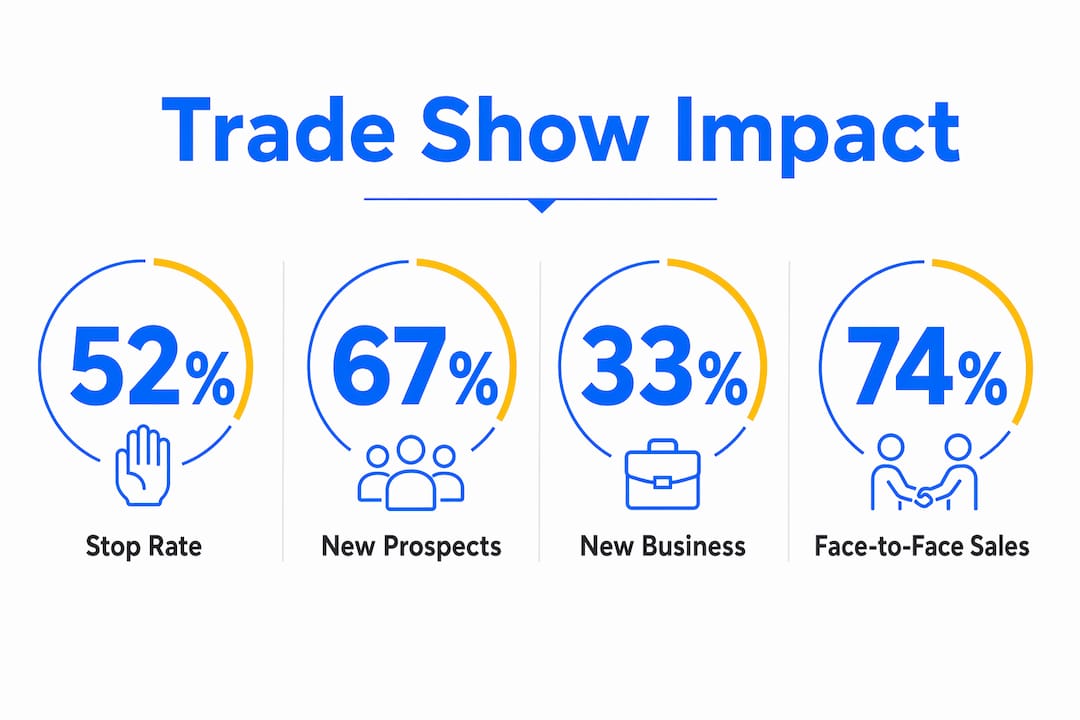
Trade show displays are the primary factor determining whether high-intent attendees stop at your booth, engage with your team, and enter your sales pipeline. Stand design accounts for 52% of the variance in stop rate at trade fairs. That single statistic reframes the entire conversation: your display is not decoration. It is your most controllable performance variable on the show floor. With 46% of trade show attendees already in final buying stages, a weak display does not just cost you foot traffic. It costs you sales-ready conversations.
Why trade show displays matter more than most exhibitors realize
Most exhibitors treat booth design as an aesthetic choice. It is actually a strategic filter that determines lead quality before conversations begin. The display signals to every passing attendee whether your brand is worth their time. Get that signal wrong and no amount of great sales staff will recover the lost traffic.
The industry term for this concept is “exhibition stand design,” and it covers everything from graphic hierarchy and lighting to layout and material quality. Understanding why trade show presence is important starts with accepting that attendees make snap judgments. Attendees form an opinion within 3–8 seconds of seeing a booth. That window is shorter than most people’s attention span on social media.
Trade shows also contribute to 33% of new business, and attendees who meet face to face are 74% more likely to purchase afterward. The display is the mechanism that gets them to stop and have that face-to-face conversation. Without it working correctly, the entire investment in attending the event underperforms.
How does booth design affect attendee behavior?
Booth design shapes attendee behavior through three measurable channels: visual attraction, physical layout, and brand consistency. Each one influences whether a visitor stops, stays, or walks past.
Visual attraction is the first filter. Bold graphics, high-contrast color, and proper lighting pull attention from across a crowded aisle. Booth graphics that use large-format imagery and clear brand messaging outperform cluttered, text-heavy displays every time. Lighting is particularly underused. A well-lit booth reads as more professional and draws the eye even when neighboring booths are visually busy.
Physical layout determines dwell time. Effective booth layouts avoid barriers that discourage entry and use multiple entry points to maximize visitor engagement. A counter placed directly at the booth entrance blocks natural foot traffic. Open layouts with clear sightlines invite attendees in rather than stopping them at the threshold.
Brand consistency builds recall. When your display, staff uniforms, printed materials, and digital screens share the same color palette, typography, and messaging, attendees form a stronger mental anchor for your brand. That recall matters after the show, when buyers are comparing vendors and making final decisions.
- Use high-contrast visuals and large-format graphics as the primary attraction layer
- Place counters and product displays inside the booth, not at the entrance
- Match all printed materials to the display’s color and font system
- Add lighting to create depth and draw attention from adjacent aisles
- Keep messaging to one primary claim per visual panel
Pro Tip: Design your display so the core brand message is readable from 15 feet away. If a passerby cannot read your headline from across the aisle, your display is working too hard at close range and not hard enough at distance.
What is the measurable ROI of a quality trade show display?
The business case for investing in quality exhibition displays is direct and quantifiable. A standard 10x10 booth costs $7,000–$18,000, and the actual total cost often doubles that figure once travel, staffing, freight, and accommodation are added. That scale of investment demands a display that performs.
Custom-designed stands generate 38% more qualified leads per square meter than generic booths. They also produce 19% higher post-show conversion rates. Those two numbers together mean a quality display does not just attract more people. It attracts better people and converts them at a higher rate after the event.
“Low-quality displays increase total cost by reducing visitor engagement and lead conversion. The display budget is not a line item to cut. It is the multiplier on every other dollar spent at the show.”
The table below summarizes the key performance differences between generic and custom-designed displays.
| Metric | Generic display | Custom-designed display |
|---|---|---|
| Stop rate influence | Below average | 52% of variance in stop rate |
| Qualified leads per sq. meter | Baseline | 38% higher |
| Post-show conversion rate | Baseline | 19% higher |
| Attendee purchasing authority | Same pool | 81% have buying authority |
| New prospects in audience | Same pool | 67% are new to the exhibitor |
The 67% new-prospect figure is particularly significant. Most of the people walking past your booth have never heard of your company. Your display is doing cold outreach at scale. A generic booth wastes that opportunity entirely.
How do trade show displays fit into a broader marketing strategy?
Trade show displays work best when they function as one node in a connected marketing and sales system, not as a standalone event tactic. Trade shows converge digital intelligence with live interaction to turn passive visits into measurable sales pipeline. That convergence only works when the display is designed to support it.
Pre-show preparation is the most underused lever. Successful exhibitors set precise, measurable objectives rather than vague goals like “get leads.” They schedule meetings before the event, identify target accounts by intent signals, and design their booth layout to support specific conversation types. A display built for product demonstrations needs different spatial logic than one built for brand awareness.
The trade show booth checklist approach treats the display as a system with interdependent parts. Each element, from the backdrop to the table cover to the retractable banner, serves a defined role in guiding visitors through a planned experience.
Behavioral signal capture is the next frontier. Booths designed with interactive elements, digital screens, and structured engagement flows generate richer CRM data than passive badge-scanning setups. That data quality difference compounds over time. Better event data means better follow-up targeting, which means higher close rates on leads generated months earlier at the show.
- Set specific, measurable objectives before the event (number of qualified conversations, not total badge scans)
- Schedule meetings with target accounts before the show opens
- Design the booth layout to support the primary objective, whether that is demos, conversations, or brand exposure
- Use interactive elements to capture behavioral signals beyond contact information
- Align post-show follow-up sequences with the specific conversations held at the booth
Practical tips for designing effective trade show displays
Effective exhibition display design follows a set of principles that apply regardless of booth size or budget. The goal is to maximize the number of qualified visitors who stop, engage, and provide contact information.
-
Lead with one clear message. Every display needs a single primary headline that communicates what you do and who you serve. Attendees will not read a paragraph. They will read six words if those words are large enough and placed at eye level.
-
Use the right display type for your objective. A tension fabric backdrop creates a clean, professional backdrop for conversations and photography. A retractable banner stand works for directional signage or secondary messaging. An SEG lightbox display adds backlit depth that commands attention in low-light exhibition halls. Match the format to the function.
-
Plan your booth layout for traffic flow. Open the front of the booth completely. Place product displays and demo stations toward the back and sides. This draws visitors in rather than stopping them at the perimeter.
-
Add interactive or experiential elements. Product demos, touchscreen kiosks, and live presentations increase dwell time. Longer dwell time correlates directly with higher lead quality because visitors who stay longer are self-selecting as genuinely interested.
-
Maintain consistent branding across every printed element. The backdrop, table cover, banner stands, and handout materials should all look like they came from the same design file. Inconsistency signals a lack of preparation and undermines brand credibility.
Pro Tip: Print a physical proof of your display graphics at full scale before the event if possible. Colors shift between screen and print, and catching a mismatch at home costs far less than discovering it on the show floor.
Key Takeaways
Trade show display effectiveness is determined by design quality, layout strategy, and integration with pre-show and post-show marketing systems.
| Point | Details |
|---|---|
| Display design drives stop rate | Stand design accounts for 52% of stop rate variance, making it the largest controllable factor at any event. |
| Custom displays outperform generic ones | Custom stands generate 38% more qualified leads and 19% higher post-show conversion rates than generic booths. |
| Total event cost doubles the booth budget | Travel, staffing, and freight typically double the booth spend, making display quality a cost-efficiency issue. |
| Layout determines dwell time | Open entry points and interior product placement increase visitor engagement and lead quality. |
| Pre-show preparation multiplies ROI | Setting measurable objectives and scheduling meetings before the event improves outcomes more than booth size alone. |
The real reason most exhibitors underperform at trade shows
Most exhibitors underperform not because their product is weak but because they treat the display as a last-minute logistics item rather than a front-line sales tool. I have seen companies spend six figures on booth space and then cut the display budget to save a few thousand dollars. The result is a forgettable presence in a hall full of competitors who made the opposite choice.
The data is clear on this. Trade show success depends more on preparation, focus, and follow-through than on booth size or flashiness. But preparation includes the display. A well-designed booth acts as a strategic marketing asset that influences footfall, lead quality, brand recall, and staff performance. It is not decorative. It sets the context for every conversation your team has that day.
The exhibitors who consistently generate pipeline from trade shows treat their display as a precision investment. They brief their designers on specific audience personas. They test graphic layouts before committing to print. They align every visual element with the one message they want attendees to remember. That level of preparation is available to any company willing to treat the display budget as seriously as the event registration fee.
Printdrill’s trade show display products for serious exhibitors
Professional trade show results start with professional display materials. Printdrill offers a full range of exhibition display products built for exhibitors who need quality, speed, and consistency across every event.
The 10x20 tension fabric booth kit delivers a complete, customizable exhibition presence with clean graphics and fast setup. For exhibitors who need high-visibility signage, Printdrill’s custom mesh banners and fabric banners are printed on commercial-grade materials with vibrant, color-accurate output. Free design assistance is available for customers who need help preparing print-ready artwork. Nationwide shipping covers every U.S. market, with fast turnaround options for tight event timelines.
FAQ
Q: Why do trade show displays matter for lead generation?
A: Trade show displays are the primary factor controlling whether attendees stop at a booth. Stand design accounts for 52% of stop rate variance, and 46% of attendees are already in final buying stages, making display quality directly tied to lead volume and quality.
Q: How much does a professional trade show display cost?
A: A standard 10x10 booth space costs $7,000–$18,000, and total event costs typically double that figure when travel, staffing, and freight are included. Investing in a quality custom display maximizes the return on that total spend.
Q: What makes a custom display better than a generic one?
A: Custom-designed stands generate 38% more qualified leads per square meter and achieve 19% higher post-show conversion rates than generic booths. The design signals brand credibility before any conversation begins.
Q: How fast do attendees judge a trade show booth?
A: Attendees form an opinion about a booth within 3–8 seconds. That window makes visual clarity and strong graphic hierarchy the most critical design priorities for any exhibition display.
Q: What display types work best for trade shows?
A: Tension fabric backdrops, SEG lightbox displays, retractable banner stands, and modular booth kits each serve different objectives. Match the display format to your primary goal, whether that is brand awareness, product demonstration, or lead capture.
