

What Is a Yard Sign? Uses, Types, and Design Tips
TL;DR:
- Yard signs are durable, weather-resistant signs placed in soil to promote messages, businesses, or events. They provide persistent local exposure, helping build awareness and trust within specific geographic areas.
A yard sign is a small, rigid outdoor sign placed in soil or grass to communicate a message, promote a business, or direct people to an event. Also called a lawn sign or campaign sign, these signs appear everywhere from residential streets to busy commercial corridors. The industry-standard size is 18" x 24" made from 4mm corrugated polypropylene, readable by drivers moving at 25–35 mph. Printdrill produces custom yard signs built to these same standards, serving businesses, real estate agents, event organizers, and homeowners across the United States.
What is a yard sign, and how does it work?
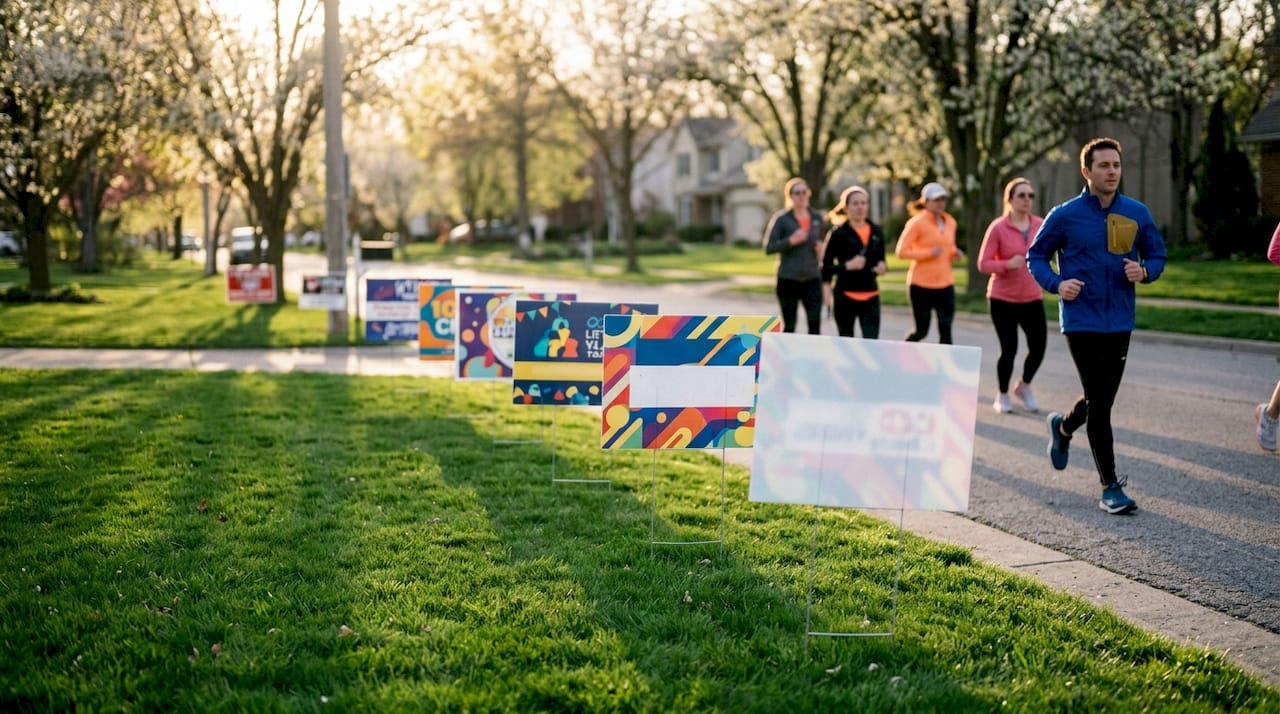
A yard sign is a printed flat panel, typically made from corrugated plastic, mounted on a wire stake pushed into the ground. The sign faces passing foot and vehicle traffic, delivering a message repeatedly to anyone who moves through that area. Unlike a digital ad that disappears after a few seconds, a yard sign stays visible 24 hours a day for as long as it remains in place. That persistent, hyperlocal exposure builds awareness and trust in a specific geographic area over time.
The term “lawn sign” is used interchangeably with yard sign in most contexts. “Campaign sign” refers to the same product when used in political settings. All three names describe the same basic format: a flat printed panel on a ground stake.
Materials, sizes, and construction standards
Corrugated polypropylene: the standard material
Corrugated polypropylene, commonly called coroplast, is the material used in nearly every yard sign on the market. It is a twin-wall plastic sheet with vertical internal flutes running between two flat outer layers. Those flutes give the board its rigidity without adding significant weight. The material is also weather-resistant, meaning it holds up against rain, wind, and UV exposure without warping or fading quickly.
The standard thickness is 4mm. This gauge works well for short-term use such as a weekend event, a garage sale, or a one-month promotion. For longer campaigns, such as a real estate listing that may sit outdoors for several months, heavier-gauge boards prevent warping and extend the sign’s usable life. Choosing the right thickness upfront saves money by avoiding early replacement.
Standard sizes and when to go larger
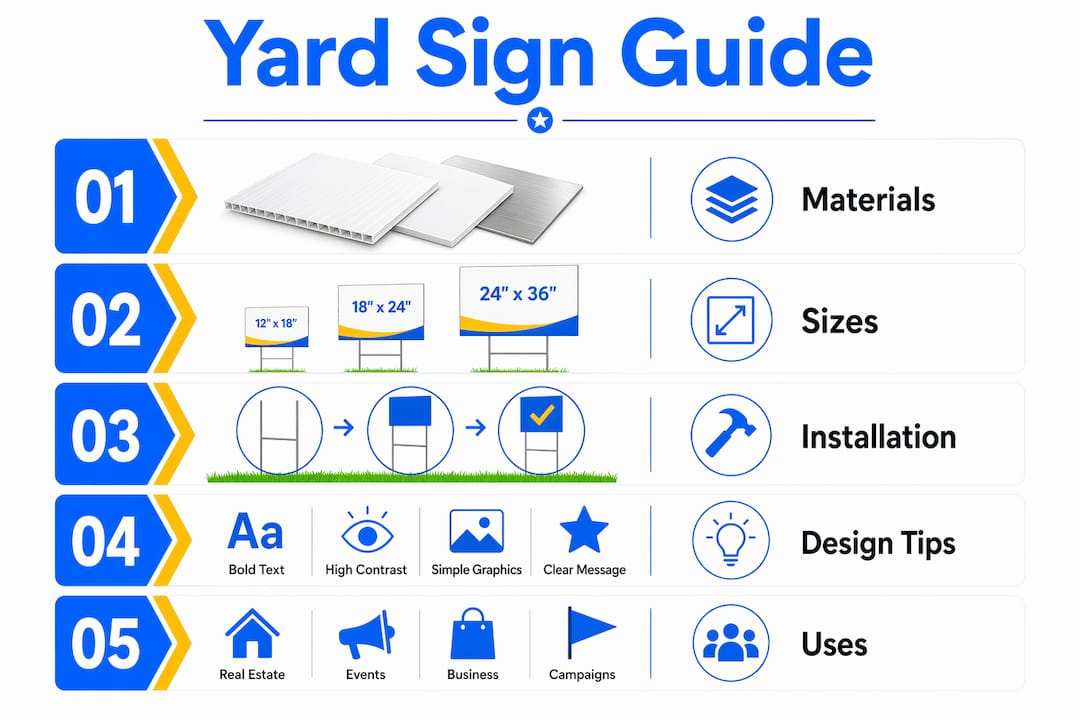
| Size | Best Use | Typical Letter Height |
|---|---|---|
| 18" x 24" | Residential streets, standard campaigns | 4–5 inch headlines |
| 24" x 36" | Busy arterial roads, high-traffic areas | 5–6 inch headlines |
| 12" x 18" | Directional signs, indoor use | 2–3 inch headlines |
The 18" x 24" format accommodates 4–5 inch letters for headlines and 2-inch letters for contact details. On busy roads where drivers pass at higher speeds, 24" x 36" signs maintain readability where smaller formats fail. Choosing the wrong size for the location is one of the most common and avoidable mistakes.
H-stakes and installation hardware
H-stakes are metal wire frames shaped like the letter “H” that slide directly into the corrugated flutes of the sign panel. They hold the sign upright in soil without adhesives or tools. The standard H-stake for an 18" x 24" sign measures 10" x 30". H-stakes are reusable, which matters for businesses running multiple campaigns across different locations.
Pro Tip: Push H-stakes into the ground at a slight forward angle, leaning the sign face toward oncoming traffic. This keeps the sign visible even when wind pushes against the back panel.
How to design a yard sign that actually gets read
Limit your message to four elements
Effective yard sign design gives a viewer three seconds or less to absorb the primary message. That constraint forces a clear hierarchy. The four elements that belong on most yard signs are:
- Logo or brand mark: placed prominently so viewers connect the message to a name
- Headline or name: the single most important piece of information, in the largest font
- Phone number or URL: one contact method only, in a readable size
- Short tagline or call to action: optional, but only if space allows without crowding
Anything beyond these four elements reduces legibility. A fifth line of text does not add information for a driver passing at 30 mph. It just makes everything harder to read.
Font size and color contrast
Primary text should be large, bold, and high-contrast for legibility at 25–50 feet. Black text on a white or yellow background and white text on a dark blue or red background both perform well at distance. Avoid light gray on white, yellow on white, or any combination where the text blends into the background under outdoor lighting conditions.
The most common design mistake is overcrowding the sign with too much information. Designers often reduce font size to fit more content, which defeats the purpose entirely. If the message does not fit at a readable size, cut the message, not the font.
Pro Tip: Test your design by printing it on a standard sheet of paper, placing it on the ground, and reading it from 15 feet away. If you struggle, the font is too small or the contrast is too low.
Adapting design to placement context
A sign placed on a quiet residential street can carry slightly more detail because pedestrians and slow-moving vehicles have more time to read it. A sign on a four-lane arterial road needs maximum simplicity. The placement context should drive every design decision, from font size to the number of words in the headline.
What types of yard signs are used for?
Yard signs serve a wide range of purposes across personal, commercial, and civic settings. The most common categories include:
- Political and campaign signs: candidate name, party affiliation, and election date. These are the most recognizable form of lawn sign in the United States.
- Real estate signs: “For Sale,” “For Rent,” or “Open House” with agent contact details. Real estate agents rely on these for neighborhood-level visibility.
- Business promotion signs: contractors, landscapers, HVAC companies, and other service businesses place signs at job sites to generate leads from neighbors.
- Event directional signs: weddings, community fundraisers, and garage sales use small directional signs to guide attendees from main roads to the venue.
- Personal and residential uses: graduation announcements, birthday displays, and “Welcome Home” messages placed in front yards.
The versatility of yard signs comes partly from customization options. Shapes can be cut to match a logo or product outline. Double-sided printing lets a sign communicate to traffic moving in both directions. Weather-resistant coatings extend outdoor life in high-humidity or high-UV environments.
Businesses that use yard signs at job sites gain a specific advantage. Neighbors see the sign, recognize the brand, and associate it with work being done nearby. That implied endorsement from a neighbor’s property carries more weight than a cold digital ad. You can explore the full range of applications in this yard sign types guide from Printdrill.
How to use yard signs for maximum impact
-
Choose high-visibility locations. Place signs where traffic volume is highest, at intersections, near driveways, and along the main road leading to your business or event. Avoid placing signs behind parked cars, overgrown shrubs, or utility poles that block the face.
-
Check local regulations before installing. Most municipalities regulate sign placement near roads, on public property, and in residential zones. Height limits and setback requirements vary by city. Violating these rules results in signs being removed by code enforcement.
-
Install with H-stakes correctly. Slide the stake into the flutes before pushing into the ground. A sign installed without a stake or with a stake that does not fit the flute size will lean, fall, or spin in wind.
-
Plan for weather and campaign length. A 4mm coroplast sign holds up well for events lasting a few days to a few weeks. For campaigns running two months or longer, use heavier-gauge boards. Inspect signs after heavy rain or wind and reset any that have shifted.
-
Calculate cost against impressions. A single yard sign costing $3–$8 can generate hundreds or thousands of impressions over several weeks. That cost per impression is far lower than most digital advertising formats. Deploying multiple signs across a neighborhood multiplies exposure without multiplying cost proportionally.
-
Use consistent branding across multiple signs. When several signs appear in the same area, they reinforce each other. Consistent colors, fonts, and logos build perceived credibility. A contractor whose signs appear on three houses on the same block looks more established than one with a single sign.
Key Takeaways
Yard signs deliver consistent, low-cost local exposure that digital ads cannot replicate, making them one of the most cost-efficient tools in any local marketing or event promotion plan.
| Point | Details |
|---|---|
| Standard material and size | 4mm corrugated polypropylene at 18" x 24" is the industry baseline for most campaigns. |
| Design simplicity wins | Limit each sign to four elements: logo, headline, contact, and one optional tagline. |
| Match size to traffic speed | Use 24" x 36" signs on busy roads where drivers have less time to read. |
| H-stakes are reusable | Standard 10" x 30" H-stakes slide into coroplast flutes and can be reused across campaigns. |
| Cost per impression is low | A sign costing $3–$8 can generate thousands of impressions over several weeks outdoors. |
Why yard signs still outperform expectations
Yard signs combine immediate marketing impact with practical navigation assistance, serving diverse roles at very low cost. After working with signage across dozens of industries, I keep coming back to the same observation: businesses consistently underestimate what a well-placed yard sign does to local brand perception.
The digital-first assumption is that physical signs are outdated. That assumption is wrong. A yard sign does something a digital ad cannot. It sits in a neighbor’s yard. That physical placement implies a social endorsement, even when none was explicitly given. People notice it repeatedly on their daily commute. Repetition builds familiarity, and familiarity builds trust.
The biggest mistake I see is not the wrong size or the wrong material. It is overcrowding. Businesses try to put their full value proposition on a 18" x 24" panel. The result is a sign that communicates nothing clearly. One strong headline and a phone number will outperform a paragraph of benefits every time.
For real estate agents and contractors, I recommend keeping a stock of heavier-gauge boards for any campaign expected to run beyond six weeks. The cost difference between 4mm and heavier coroplast is small. The difference in sign condition after two months of outdoor exposure is significant. A warped or faded sign reflects poorly on the brand it represents.
Yard signs also pair well with other outdoor formats. A sign at the street combined with a metal A-frame sign near the entrance creates a layered presence that guides visitors from the road to the door.
Printdrill custom yard signs and outdoor signage
Printdrill produces custom yard signs built to industry standards, using 4mm corrugated polypropylene with full-color printing and optional double-sided layouts. Orders include H-stakes and ship nationwide with fast turnaround options.
For businesses running broader outdoor campaigns, Printdrill also offers complementary products including for-sale banners for property marketing and metal A-frame signs for entrance and directional use. Free design assistance is available for customers who need help preparing print-ready artwork. Upload your design, approve a digital proof, and receive your order delivered directly to your location.
FAQ
What is the standard size for a yard sign?
The industry-standard yard sign size is 18" x 24", made from 4mm corrugated polypropylene. This size is readable by drivers at 25–35 mph and fits standard H-stakes.
What material are yard signs made from?
Most yard signs use corrugated polypropylene, also called coroplast. It is lightweight, rigid, and weather-resistant, making it suitable for outdoor use in most climates.
How long do yard signs last outdoors?
A 4mm coroplast sign holds up well for short campaigns of a few days to a few weeks. Heavier-gauge boards extend usable life to several months without warping or fading.
What is an H-stake and do I need one?
An H-stake is a metal wire frame that slides into the corrugated flutes of a yard sign to hold it upright in soil. The standard size for an 18" x 24" sign is 10" x 30", and it is required for proper outdoor installation.
Are yard signs effective for business marketing?
Yes. A single yard sign costing $3–$8 can generate hundreds to thousands of impressions over several weeks, making the cost per impression significantly lower than most digital advertising formats.
