

What Is a Vinyl Banner? Materials, Printing, and Uses
A vinyl banner is a large-format printed sign made from PVC-coated polyester scrim, designed for promotional displays, event signage, and brand advertising in both indoor and outdoor settings. The industry term is “PVC banner,” though vendors use vinyl and PVC interchangeably to describe the same core material. For marketing professionals, event planners, and small business owners, vinyl banners remain one of the most cost-effective and durable signage formats available. They hold up in weather, reproduce full-color graphics sharply, and scale from a 2-foot counter display to a 10-foot outdoor backdrop without losing structural integrity.
What is a vinyl banner and how is it constructed?
A vinyl banner is defined as a PVC-coated polyester scrim sign that combines a woven mesh base with a flexible plastic coating to create a surface that resists tearing, stretching, and moisture. The polyester scrim acts as the structural backbone, while the PVC coating provides the smooth, printable face. This two-layer construction is what separates vinyl banners from simple plastic sheets or fabric prints.
The scrim weave density determines how much the banner flexes under wind load. A tighter weave means less stretch and better dimensional stability, which matters when a banner is mounted between two poles at an outdoor festival or stretched across a storefront. The PVC surface accepts ink without absorption, which is why vinyl banners produce sharper image detail than porous fabric alternatives.
Most commercial vinyl banners fall into two weight categories: 13 oz and 16 oz. The weight refers to the material’s mass per square yard, not its thickness alone. Heavier material means more PVC coating, which translates directly to better tear resistance and longer outdoor life.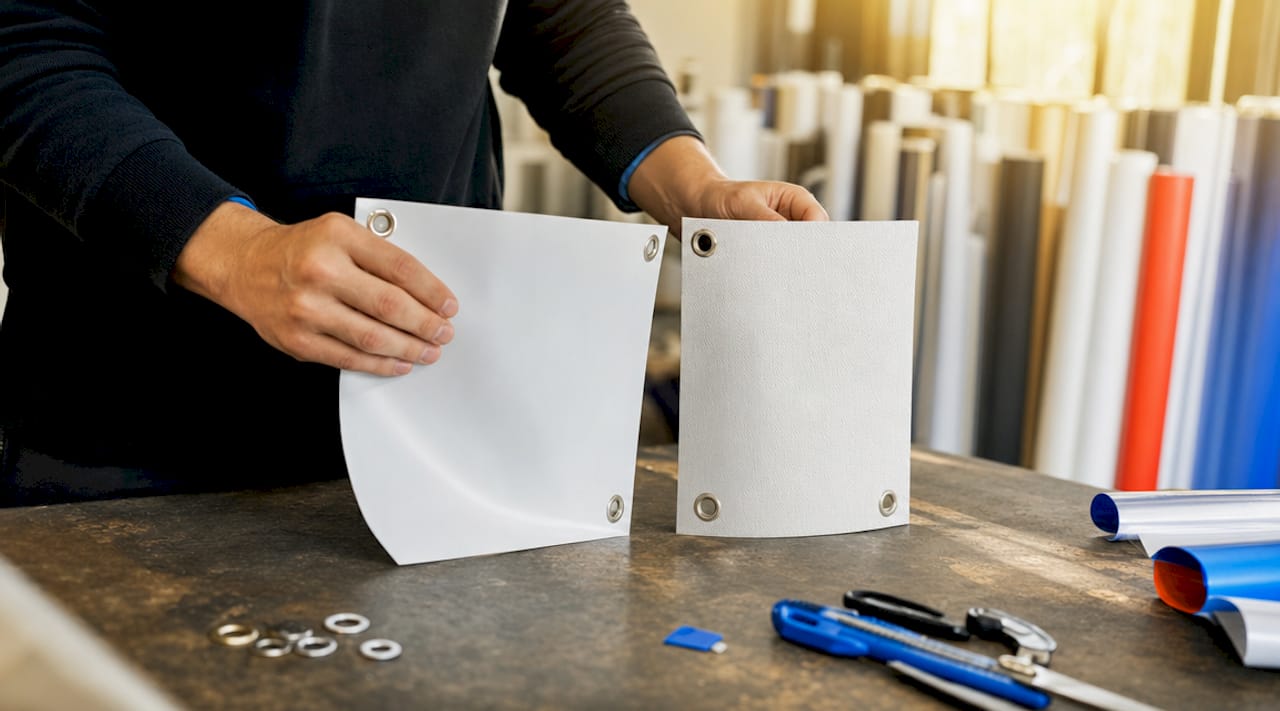
How are vinyl banners made and printed?
Vinyl banner printing follows a defined production workflow that moves from digital file preparation through large-format printing and into physical finishing. Each stage affects the final product’s durability and visual quality.
The standard production process works as follows:
-
File preparation. Artwork is set up at the correct output resolution, typically 100 to 150 DPI at full print size, with bleed margins added for finishing. Color profiles are converted to CMYK for accurate ink reproduction.
-
Large-format printing. The vinyl substrate feeds through a wide-format printer that applies ink in precise layers. Printers use solvent, eco-solvent, or UV ink systems depending on the production environment and end-use requirements.
-
Ink curing. UV inks cure instantly under a UV lamp mounted inside the printer, allowing the banner to move directly to finishing. Eco-solvent inks bond chemically with the PVC surface through a mild swelling process, requiring heat and drying time before handling.
-
Hemming. The printed vinyl sheet is folded and heat-welded along all four edges to create a reinforced border. This prevents fraying and gives the banner a clean, finished appearance.
-
Grommet installation. Metal grommets are punched and set at regular intervals along the hemmed edges. Grommets are the attachment points for rope, zip ties, or bungee cords when mounting the banner outdoors.
-
Quality inspection. The finished banner is checked for color accuracy, hem integrity, and grommet placement before shipping.
The ink type matters more than most buyers realize. Eco-solvent inks penetrate the vinyl surface, embedding pigment particles into the PVC for a mechanical bond that resists fading and weathering. UV inks sit on top of the surface after curing, which produces vivid colors quickly but can be less flexible on vinyl under repeated stress. For outdoor banners exposed to wind and temperature changes, eco-solvent printing generally delivers better long-term performance.
Pro Tip: When ordering custom vinyl banners for outdoor use, ask your printer specifically whether they use eco-solvent or UV inks. Eco-solvent is the better choice for banners that will stay up for weeks or months in direct sunlight.
Proper finishing is not cosmetic. Hemming, grommets, and welding are what convert a printed vinyl sheet into a banner that withstands wind load and repeated installation cycles. A banner without reinforced edges will tear from its mounting points within days of outdoor exposure.
What are the differences between vinyl banners and fabric banners?
Vinyl and fabric banners serve different use cases, and choosing the wrong material for a specific application wastes budget and reduces impact. The core differences come down to material composition, print quality, durability, and display environment.
| Feature | Vinyl banner | Fabric banner |
|---|---|---|
| Base material | PVC-coated polyester scrim | Woven polyester or polyester-spandex |
| Surface texture | Smooth, non-porous | Soft, slightly textured |
| Print quality | Sharp, high-contrast, vivid colors | Rich colors, slight diffusion on texture |
| Weather resistance | High. Suitable for extended outdoor use | Low to moderate. Best for indoor use |
| Weight | Heavier (13 oz to 16 oz typical) | Lighter, easier to transport |
| Typical use | Outdoor events, storefronts, trade shows | Indoor displays, photo backdrops, trade show booths |
| Cost | Generally lower per square foot | Generally higher per square foot |
The key distinctions for practical decision-making:
-
Outdoor durability. Vinyl banners handle rain, wind, and UV exposure far better than fabric. A custom fabric banner used outdoors will fade and degrade within weeks, while a properly finished vinyl banner can last one to three years in the same conditions.
-
Indoor visual quality. Fabric banners produce a premium, wrinkle-resistant appearance that photographs well and reads as more upscale in trade show or retail environments. Vinyl can show glare under bright indoor lighting if a gloss finish is used.
-
Portability. Fabric banners weigh significantly less and fold without cracking, making them easier to pack and ship for traveling events. Vinyl banners roll rather than fold to avoid crease marks.
-
Price. Vinyl is the more affordable option for large-format outdoor signage. Fabric costs more per square foot but justifies the price for high-visibility indoor brand displays.
For most outdoor promotions, grand openings, and street-facing signage, vinyl is the correct choice. For trade show backdrops, step-and-repeat displays, and upscale retail environments, fabric delivers a better result.
What vinyl banner variations exist and how do you choose the right one?
Vinyl banners are not a single product. Material weight, finish, size, and reinforcement options each affect performance in specific applications. Selecting the right combination before ordering prevents costly reprints.
Material weight is the most consequential specification:
-
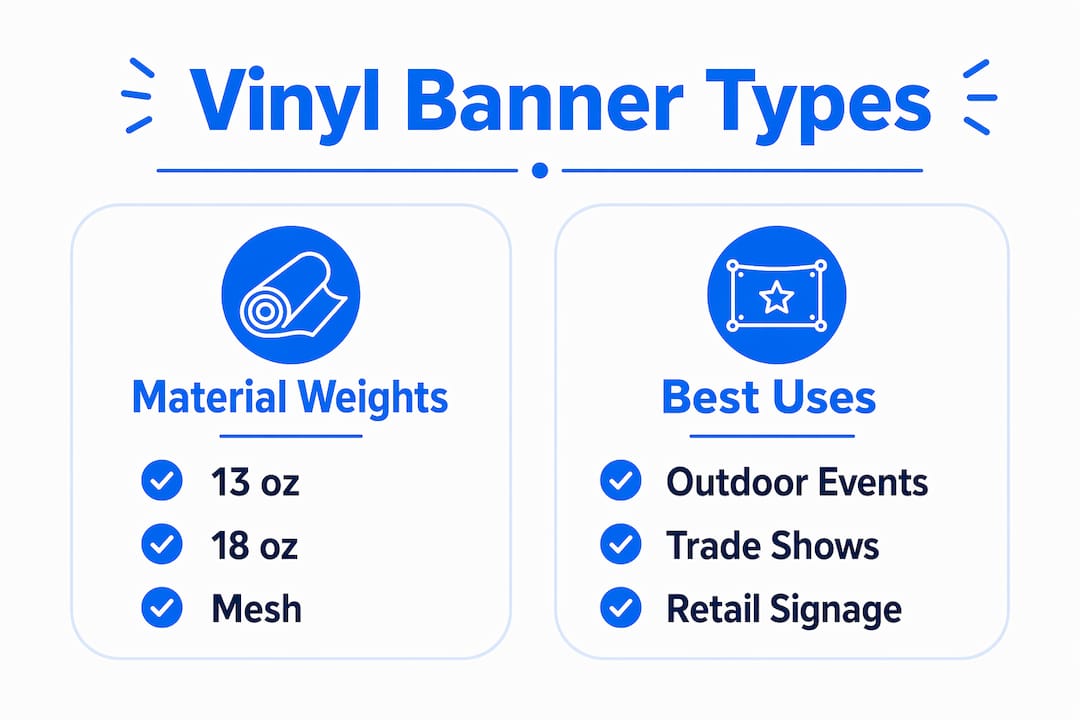
13 oz vinyl is the standard weight for most promotional banners. It balances flexibility with durability and works well for indoor displays, short-term outdoor use, and events lasting a few days. It is lighter and easier to handle.
-
16 oz vinyl is the heavy-duty option. Heavier vinyl weights increase wind resistance and tear resistance, making 16 oz the right choice for banners mounted outdoors for weeks or months, or in high-wind locations like rooftops, fences, or construction site hoardings.
Finish selection affects visibility in different lighting conditions:
-
Gloss finish amplifies color saturation and contrast, making it the better choice for shaded outdoor locations or indoor environments with controlled lighting. Gloss can create glare in direct sunlight or under bright overhead lights.
-
Matte finish diffuses light evenly, reducing glare and improving readability in bright outdoor conditions. Matte reduces reflection in sunlight while maintaining accurate color reproduction.
Size and reinforcement decisions depend on display method. Standard banner sizes run from 2 feet by 4 feet up to 4 feet by 8 feet for most retail and event applications. Custom sizes are available for specific mounting situations. For any banner wider than 4 feet, request pole pockets in addition to grommets. Pole pockets allow the banner to slide onto a horizontal rod, distributing tension evenly across the full width rather than concentrating stress at individual grommet points.
Pro Tip: For outdoor banners in windy regions, consider a mesh banner instead of solid vinyl. Mesh material allows wind to pass through, reducing the load on mounting hardware and significantly extending the banner’s usable life.
Custom sizes are worth ordering when standard dimensions do not fit the mounting location. Forcing a standard-size banner into an undersized space with excess material folded behind it looks unprofessional and creates wind-catching pockets that stress the grommets.
How to effectively use vinyl banners for marketing and events
Vinyl banners generate the most impact when placement, design, and maintenance decisions are made deliberately rather than as afterthoughts. The following sequence covers the full deployment cycle.
-
Choose placement before finalizing size. Measure the mounting location first, then order the banner. A banner that fits the space precisely looks intentional. One that hangs loose or gets trimmed looks improvised.
-
Design for distance. Most outdoor vinyl banners are read from 10 to 50 feet away. Use a minimum 3-inch letter height for every 10 feet of viewing distance. Limit the banner to one primary message, one supporting detail, and one call to action. More text reduces readability at distance.
-
Use high-contrast color combinations. Black on yellow, white on dark blue, and black on white are the highest-contrast pairings for outdoor readability. Avoid light text on light backgrounds regardless of how the design looks on screen.
-
Combine banners with complementary materials. A vinyl banner at the entrance of a trade show booth works best when paired with a retractable banner stand inside the booth and a custom pole banner at the perimeter. Consistent branding across multiple formats reinforces brand recognition.
-
Install correctly to prevent damage. Use bungee cords rather than rigid rope when mounting outdoor banners. Bungee cords absorb wind shock instead of transmitting it directly to the grommets. Check tension after the first 24 hours, as vinyl stretches slightly after initial installation.
-
Clean and store properly. Wipe vinyl banners with a damp cloth and mild soap. Avoid abrasive cleaners that scratch the PVC surface. Roll banners around a cardboard tube for storage rather than folding them, which creates permanent crease lines that show in the print.
Key takeaways
Vinyl banners are the most practical large-format signage option for outdoor promotions and events because their PVC construction, finishing quality, and material weight directly determine how long they perform and how well they display your brand.
| Point | Details |
|---|---|
| Core material | Vinyl banners use PVC-coated polyester scrim for durability, tear resistance, and sharp print quality. |
| Ink type matters | Eco-solvent inks bond into the PVC surface for better outdoor durability; UV inks cure faster but are less flexible. |
| Weight selection | Choose 13 oz for short-term or indoor use; use 16 oz for extended outdoor or high-wind applications. |
| Vinyl vs. fabric | Vinyl outperforms fabric outdoors; fabric delivers a premium look for indoor and trade show environments. |
| Finishing is structural | Hemming, grommets, and welding determine how long a banner survives wind load and repeated handling. |
Why finishing details matter more than most buyers expect
Most buyers focus on print quality and price when ordering vinyl banners. Both matter, but the finishing specification is what actually determines whether a banner lasts one week or one year outdoors.
I have seen well-designed banners fail within days because the printer used thin hem tape instead of heat-welded edges, or skipped the corner reinforcement patches that distribute stress away from the grommets. The print was perfect. The banner was unusable after the first windstorm.
The other underestimated factor is material weight selection. Ordering 13 oz vinyl for a rooftop installation or a banner mounted on a chain-link fence is a predictable failure. The material is simply not rated for that wind load. Specifying 16 oz from the start costs marginally more per square foot but eliminates the reprint cost entirely.
On the design side, the most common mistake is treating a vinyl banner like a flyer. Banners are read in motion, from a distance, often in under three seconds. Every element that does not serve the primary message competes with it. One headline, one supporting line, one contact point. That is the format that works consistently across retail, events, and outdoor advertising.
The trend worth watching in 2026 is the growing use of eco-solvent printing for short-run custom orders. Production times have shortened enough that same-week turnaround on custom vinyl banners is now standard at most quality printers, which changes how event planners can use banners for last-minute promotions.
Order custom vinyl banners from PrintDrill
Printdrill produces custom vinyl banners in any size with full-color printing, reinforced hemmed edges, and metal grommets included as standard. Material options include 13 oz and 16 oz vinyl with gloss or matte finish, sized to your exact mounting dimensions.
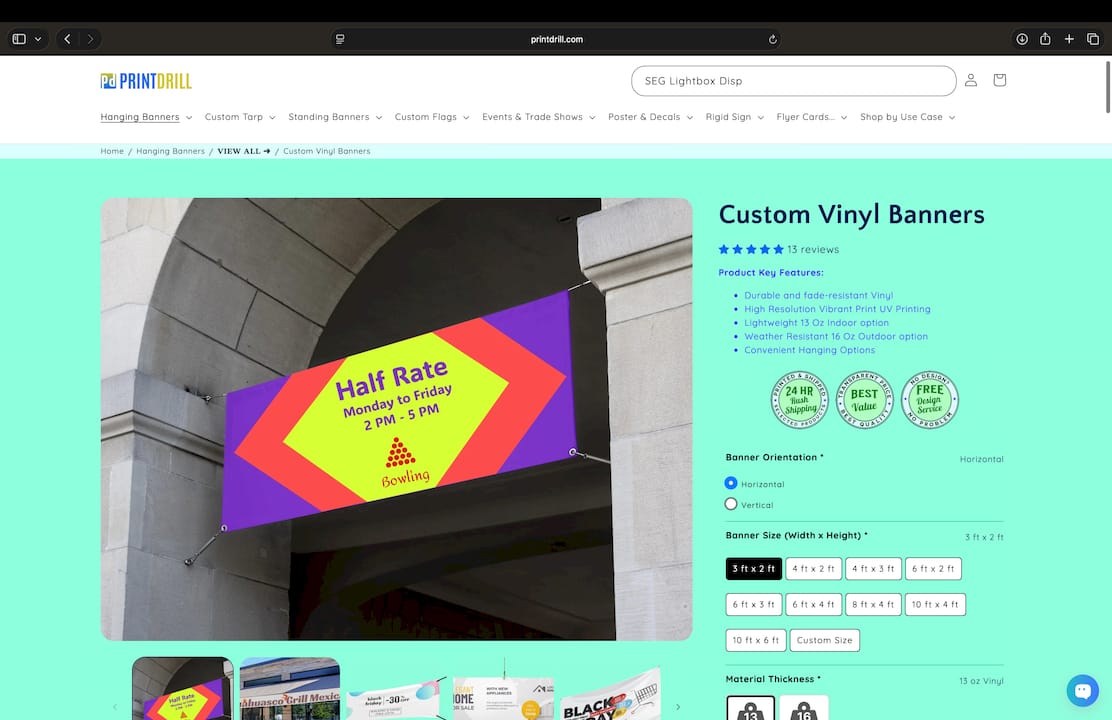
Every order includes free design assistance and a digital proof for approval before production. Fast turnaround options are available for time-sensitive events and promotions. Orders ship nationwide across the United States directly to your location. Upload your artwork, select your specifications, and receive a print-ready banner built for the conditions you need it to perform in.
FAQ
Q: What is a vinyl banner made of?
A: A vinyl banner is made from PVC-coated polyester scrim, combining a woven mesh base with a flexible plastic surface that accepts full-color ink and resists tearing, moisture, and UV exposure.
Q: How long does a vinyl banner last outdoors?
A: A properly finished vinyl banner printed with eco-solvent inks typically lasts one to three years outdoors, depending on sun exposure, wind conditions, and whether 13 oz or 16 oz material was used.
Q: What is the difference between 13 oz and 16 oz vinyl banners?
A: The weight indicates the material’s density per square yard. 13 oz is standard for short-term or indoor use, while 16 oz provides greater tear resistance and wind load capacity for extended outdoor applications.
Q: When should you choose a fabric banner over a vinyl banner?
A: Choose a fabric banner for indoor trade show displays, photo backdrops, and upscale retail environments where a soft, wrinkle-resistant appearance matters. Choose vinyl for outdoor signage, storefronts, and events where weather resistance is the priority.
Q: What ink type is best for outdoor vinyl banners?
A: Eco-solvent ink is the better choice for outdoor vinyl banners because the pigment embeds into the PVC surface, creating a weather-resistant bond that resists fading under prolonged sun and rain exposure.
