

What Is a Step Repeat Display? Event Planner's Guide
TL;DR:
- A step repeat display is a branded backdrop that repeats logos in a grid to ensure visibility in every photo. It is widely used at events like launches, trade shows, and press conferences for passive brand exposure. The choice of material, size, and logo spacing affects its effectiveness and suitability for different venues and reuse options.
A step repeat display is defined as a backdrop featuring a repeated pattern of logos or brand names arranged in a grid, designed to maximize brand exposure at events. Known formally as a step and repeat banner, this format is the standard backdrop at red carpet events, press conferences, product launches, and trade shows. Every photo taken in front of it captures the brand automatically. That passive visibility is what makes step repeat displays one of the most cost-effective branding tools available to event planners and marketing professionals.
What is a step repeat display and how does it work?
A step and repeat banner is a backdrop with logos or brand names repeated across the surface in a structured grid or staggered pattern. The repetition guarantees that at least one logo appears in every photo, regardless of where the subject stands. That is the core mechanic: no matter how the photographer frames the shot, the brand is always visible.

The term “step and repeat” refers to the design technique itself. A single logo is placed, then stepped across and repeated down the surface at consistent intervals. The result is a uniform, professional background that reads clearly in both wide shots and close-up portraits. This is why the format became the default backdrop at sponsored events, where multiple brands need equal visibility in a single frame.
Event planners use step repeat displays as what is a backdrop in its most functional form: a controlled visual environment that replaces cluttered venue walls with clean, branded imagery. The display does not compete with the event. It frames it.
How step repeat displays are designed and printed
Layout and logo arrangement
Logo spacing and size determine whether a step repeat reads clearly in photos or turns into visual noise. Logos arranged too tightly overlap and lose definition. Logos spaced too loosely leave dead space that wastes the backdrop’s surface area. The standard approach places logos in either a straight grid or a brick-style staggered pattern, with each logo sized to be legible at a distance of 6–10 feet.
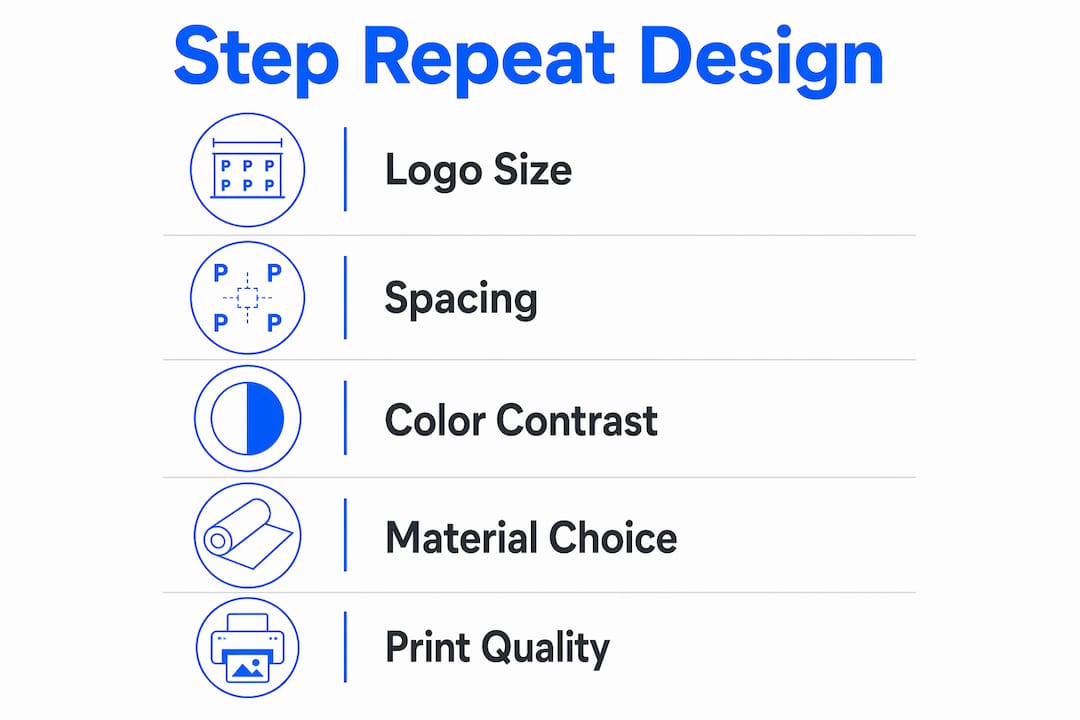
Color contrast matters as much as spacing. A dark logo on a white background, or a light logo on a dark field, photographs cleanly under event lighting. Low-contrast combinations wash out under flash photography and look muddy in social media posts. Designers working on step repeat layouts should always test the design in grayscale before finalizing, since event lighting is rarely predictable.
Pro Tip: Set your logo file to at least 300 DPI at the final print size. Scaling up a low-resolution logo at print time produces blurry results that undermine the professional appearance of the entire backdrop.
Materials and printing options
The three most common materials for step repeat backdrops are vinyl, fabric, and mesh. Each serves a different use case.
- Vinyl is durable, water-resistant, and cost-effective for single-use or short-run events. It prints with sharp color reproduction and holds up well indoors. The trade-off is weight and the tendency to crease during transport.
- Fabric (typically polyester) is wrinkle-resistant and portable, making it the preferred choice for events with frequent setup and teardown. Fabric backdrops photograph with a softer, more premium appearance than vinyl.
- Mesh is designed for outdoor use. Its perforated surface allows wind to pass through, which prevents the backdrop from acting as a sail in open-air venues. Mesh sacrifices some color density compared to solid materials but performs reliably in outdoor conditions.
Printing technology for large-format backdrops uses dye-sublimation for fabric and UV or solvent inkjet for vinyl and mesh. Dye-sublimation bonds color directly into the fabric fibers, producing vibrant results that resist fading over multiple uses.
What types of step repeat displays are available?
Step repeat backdrops come in several formats. The right choice depends on venue size, transport requirements, and how often the display will be reused.
| Format | Material | Portability | Best for |
|---|---|---|---|
| Vinyl banner with grommets | Vinyl | Low | Single-use or fixed installations |
| Fabric backdrop with stand | Polyester fabric | High | Recurring events, trade shows |
| Pop-up fabric display | Polyester fabric | High | Fast setup, portable events |
| Mesh banner | Mesh | Medium | Outdoor events, open-air venues |
| Tension fabric frame | Polyester fabric | Medium | Corporate events, permanent installs |
Pop-up fabric displays and portable stands are the most practical choice for event planners who move between venues. They pack into carry bags, set up without tools, and store flat without creasing. Vinyl banners with grommets work well for fixed installations or one-time events where transport is not a concern.
Size options range from 4x8 feet for small photo booths to 8x20 feet for large stage backdrops. Standard event sizes are 8x8 feet and 8x10 feet, which accommodate two to three people in a single frame without cutting off the background.
What are the benefits of step repeat displays for event branding?
Step repeat displays create branding consistency by replacing unpredictable venue backgrounds with a controlled, repeatable visual. Every photo taken at the event carries the same branded backdrop, which builds recognition across hundreds of individual images.
The indirect marketing value is significant. When guests post photos on social media, the branded backdrop appears in every image. That passive brand exposure extends the event’s reach far beyond the physical attendees. A single well-attended event can generate dozens of organic social media posts, each one carrying the sponsor’s logo without any additional media spend.
“A high-quality backdrop does the quiet work of event marketing by controlling visuals behind subjects, preventing clutter, and turning guest photos into consistent branded content.”
The top benefits for event branding professionals:
- Consistent brand visibility across all event photography, regardless of photographer or angle.
- Social media amplification through user-generated content featuring the branded backdrop.
- Sponsor recognition at multi-brand events, where each sponsor’s logo appears in every photo.
- Professional event aesthetics that replace cluttered venue walls with clean, intentional design.
- Reusability across multiple events when fabric or tension fabric formats are chosen.
Practical tips for selecting and using step repeat displays
Choosing the right display starts with the venue. A backdrop that works in a hotel ballroom may be too large for a conference breakout room or too small for an outdoor festival stage. Measure the available wall space before ordering, and account for the stand’s footprint, which typically adds 12–18 inches on each side.
- Size to the subject. A backdrop for individual headshots needs to be at least 6 feet wide. A backdrop for group photos or stage use should be 8–10 feet wide at minimum.
- Space logos for the camera. Logos should repeat every 18–24 inches to guarantee at least one full logo appears in a standard portrait crop.
- Plan for lighting. Backlit or side-lit setups can create glare on vinyl. Fabric absorbs light more evenly and photographs better under mixed lighting conditions.
- Choose a stand rated for the weight. Heavy vinyl banners require reinforced stands. Fabric displays work with standard pop-up or telescoping frames.
- Transport with care. Roll vinyl banners on a tube to prevent creasing. Fold fabric displays loosely and store in the provided carry bag.
Good step repeat design balances logo size and spacing to prevent clutter while keeping every logo legible. Logos spaced too tightly reduce clarity. Logos spaced too loosely waste valuable surface area.
Pro Tip: Coordinate the backdrop’s background color with the event’s overall color palette. A backdrop that clashes with table linens or stage decor draws attention to the inconsistency rather than the brand.
Key Takeaways
A step repeat display is the most reliable tool for generating consistent, branded photography at any event, and the format choice determines how well it performs across different venues and uses.
| Point | Details |
|---|---|
| Core definition | A step repeat display repeats logos in a grid across a backdrop to guarantee brand visibility in every photo. |
| Material selection | Fabric suits recurring events; vinyl fits single-use installs; mesh handles outdoor wind exposure. |
| Design precision | Logo spacing of 18–24 inches and high color contrast produce the clearest results in photography. |
| Marketing value | User-generated social media posts featuring the backdrop extend brand reach beyond physical attendees. |
| Format fit | Match the display format and size to venue dimensions and transport requirements before ordering. |
The quiet power of a well-chosen backdrop
Working with event planners across product launches, trade shows, and corporate gatherings, the pattern I see most often is this: brands spend heavily on catering, lighting, and entertainment, then cut corners on the backdrop. That decision costs them every photo taken at the event.
A step repeat backdrop is not decoration. It is the one element that appears in every photograph, every social media post, and every press image from the event. A wrinkled vinyl banner or a low-resolution logo print signals to every viewer that the brand did not take the event seriously. A clean, well-printed fabric backdrop signals the opposite, without anyone consciously noticing it.
The mistake I see most often in design is logo overcrowding. Planners assume more logos mean more visibility. The opposite is true. Tight, cluttered logos blur together in photos and become unreadable. Fewer, well-spaced logos read clearly from across a room and in a cropped social media post.
Invest in wrinkle-resistant polyester fabric if the display will be used more than once. The cost difference over vinyl is modest. The difference in appearance across multiple events is significant.
— Printdrill
Custom step repeat displays for your next event
Printdrill produces custom step and repeat backdrops in both fabric and vinyl, built for event planners who need professional results without a complicated ordering process.
Printdrill’s custom fabric banners use wrinkle-resistant polyester with full-color dye-sublimation printing, making them a practical choice for planners who reuse displays across multiple events. For outdoor applications, custom mesh banners provide wind permeability without sacrificing print quality. Free design assistance is available for planners who need help setting up the repeating logo layout before production. Orders ship nationwide with fast turnaround options to meet event deadlines.
FAQ
What is a step repeat display used for?
A step repeat display is used as a branded backdrop at events, press conferences, product launches, and trade shows to ensure sponsor or brand logos appear in every photo taken at the venue.
What is the standard size for a step and repeat banner?
The most common sizes are 8x8 feet and 8x10 feet, which accommodate individual portraits and small group photos while keeping the branded background fully visible in the frame.
What material is best for a step repeat backdrop?
Wrinkle-resistant polyester fabric is the best choice for events with repeated use, since it photographs cleanly and packs easily for transport. Vinyl suits single-use or fixed installations.
How far apart should logos be spaced on a step repeat?
Logos should repeat every 18–24 inches across the backdrop surface. That spacing guarantees at least one complete logo appears in a standard portrait crop regardless of where the subject stands.
What is the difference between a step repeat and a regular backdrop?
A regular backdrop is a single image or solid color. A step repeat banner uses a repeating logo pattern specifically designed to keep brand marks visible in every photo, regardless of framing or subject position.
