

What Is a Fabric Pop-Up Backdrop for Events?
TL;DR:
- Fabric pop-up backdrops feature a collapsible aluminum frame with tensioned fabric graphics, providing a seamless and portable display solution. They are quicker to set up, produce higher-quality visuals, and offer better long-term value than vinyl banners or traditional systems. Customizable in various sizes and shapes, these displays ensure a professional appearance while being reusable and easy to maintain.
A fabric pop-up backdrop is a portable display system built from a collapsible aluminum frame and a tensioned fabric graphic that produces a seamless, wrinkle-free visual surface for trade shows, promotional events, and branded environments. The industry standard term for this product is a tension fabric display, and both terms refer to the same core technology. Understanding how these displays are constructed, what sets them apart from vinyl banners or pipe-and-drape systems, and how to deploy them correctly will determine how much return you get from your booth investment.
Trade show professionals increasingly prefer tension fabric displays for their vibrancy, portability, and ease of setup compared to traditional vinyl or segmented panel displays. That shift reflects a real change in what exhibitors expect from portable backdrop solutions: professional appearance without the setup complexity.
What is a fabric pop-up backdrop and how is it built?
A tension fabric display consists of a collapsible aluminum frame with a stretchable fabric graphic, secured using silicone edge graphics or a pillowcase-style sleeve. The frame uses an accordion-style mechanism that expands from a compact folded position into a full-size structure in seconds. No tools are required. The frame locks into position through a series of hinged joints that hold the shape under the tension of the stretched fabric.

The fabric graphic itself is typically made from a polyester knit material. This fabric is printed using dye-sublimation, a process that infuses color directly into the polyester fibers rather than sitting on top of the surface. The result is a graphic that is vibrant, permanent, and washable. Colors do not crack, peel, or fade the way surface-applied inks do on vinyl.
Two main attachment methods are used to secure the fabric to the frame:
- Silicone edge graphics (SEG): A thin silicone strip is sewn into the perimeter of the fabric. This strip slides into a channel on the frame, pulling the graphic tight from all four edges.
- Pillowcase style: The fabric is sewn into a sleeve that slips over the entire frame, similar to a pillowcase over a pillow. This method is common on pop-up accordion frames.
The tensioning process is what produces the smooth, flat surface. When the fabric is pulled taut from every edge, wrinkles disappear and the graphic reads as a single, uninterrupted image.
Pro Tip: Before locking the frame into its final position, attach the fabric loosely first. Then tighten each locking point progressively from the center outward. This prevents uneven tension that causes visible bunching at the corners.
What advantages do fabric pop-up backdrops offer over other display options?
The most direct comparison is between fabric pop-up backdrops and three common alternatives: vinyl banners, traditional pop-up panel displays, and pipe-and-drape systems.
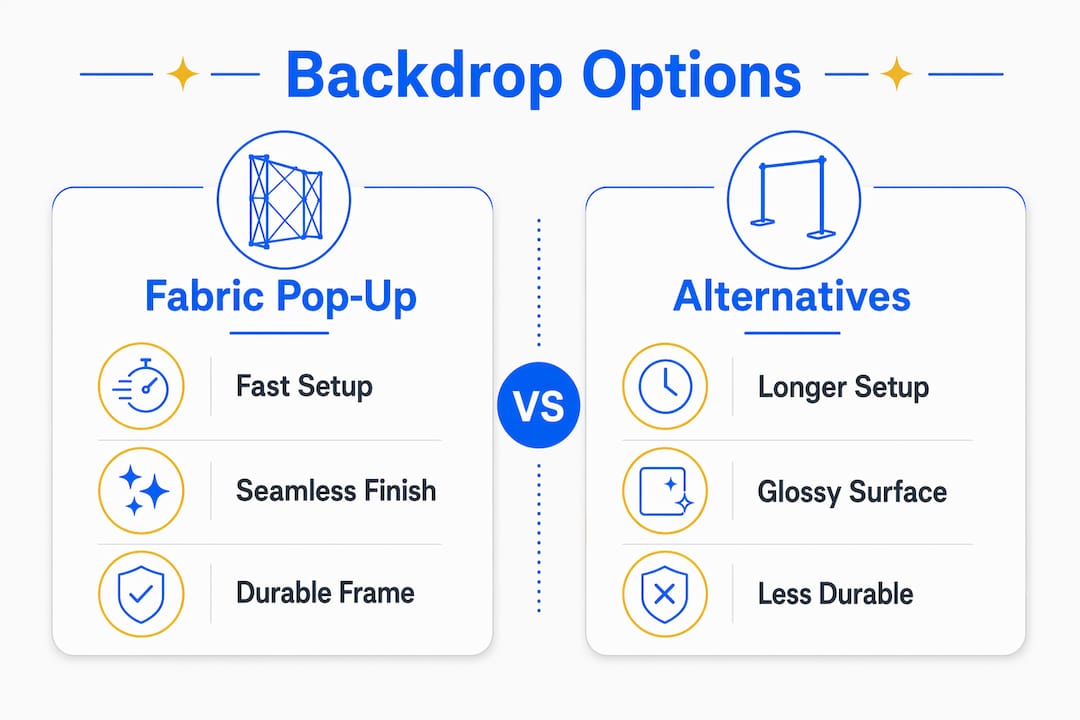
Setup time is the most immediate difference. Fabric pop-ups set up in 5 to 10 minutes by one person, while pipe-and-drape systems require 30 to 60 minutes and typically need two people. For event planners managing multiple booth elements on a tight schedule, that difference is significant. A faster setup also means more time to arrange lighting, product displays, and other booth components before the show floor opens.
Visual quality is the second major advantage. Tension fabric graphics produce a seamless, matte, non-glare finish that vinyl banners cannot replicate. Vinyl panels often show seams where sections join, and the reflective surface creates glare under trade show lighting. Fabric displays read cleanly under any lighting condition, which matters when attendees are photographing your booth or when your backdrop appears in video content.
| Feature | Fabric pop-up backdrop | Vinyl banner | Pipe-and-drape |
|---|---|---|---|
| Setup time | 5 to 10 minutes, 1 person | Under 5 minutes, 1 person | 30 to 60 minutes, 2 people |
| Visual finish | Seamless, matte, no glare | Seams visible, reflective | Fabric panels, visible hardware |
| Portability | Lightweight, compact carry bag | Rolls up, bulky for large sizes | Heavy, multiple components |
| Graphic replacement | Yes, frame reused | No, full replacement | Partial, panel by panel |
| Washability | Yes, machine washable | No | Depends on fabric type |
Long-term cost is where fabric pop-up backdrops deliver higher ROI than banner stands and modular exhibits. The frame is reused across multiple events. When your branding changes, you replace only the fabric graphic, not the entire structure. That replacement cost is a fraction of buying a new display system.
Pro Tip: Order a second fabric graphic when you first purchase your display. Storing a backup means you can swap graphics between events without waiting on a reprint if the primary graphic is damaged or needs updating.
What customization and configuration options exist for fabric pop-up backdrops?
Standard fabric pop-up backdrops come in sizes including 8x8, 10x10, and 10x20 feet, which align directly with standard trade show booth footprints. A 10x10 backdrop fills the back wall of a standard single booth. A 10x20 configuration works for inline booths or island displays where you need coverage across a wider span.
Frame shape is a meaningful choice for brand presentation:
- Straight frames produce a flat wall effect. They are the most common configuration and work well for step and repeat patterns, product photography backdrops, and clean logo presentations.
- Curved frames create a slight arc that adds depth and dimension to the booth. A curved fabric pop-up display draws the eye more effectively than a flat wall and creates a natural enclosure that defines your booth space.
- Wave-shaped frames combine straight and curved sections for a more dynamic silhouette. These are less common but effective for brands that want a distinctive booth profile.
Backlit configurations add another layer of visibility. A backlit LED pop-up display places LED lighting behind the fabric graphic, making the image glow from within. This format stands out in crowded exhibition halls where ambient lighting competes with your display. Backlit fabric requires a slightly different fabric weight to allow light transmission without washing out the printed colors.
Additional configuration options include:
- Full-color dye-sublimation printing across the entire graphic surface, including step and repeat logo layouts for media walls and photo opportunities
- Hard-shell transport cases that convert into podiums or counters at the event, reducing the number of separate items you need to ship
- Modular extensions that connect multiple pop-up frames side by side to create larger continuous backdrops for 20-foot or 30-foot booth configurations
How to use and set up fabric pop-up backdrops at trade shows
Setting up a fabric pop-up backdrop correctly takes less than ten minutes when you follow the right sequence. Skipping steps or rushing the tensioning process produces a wrinkled display that undermines the professional appearance the format is designed to deliver.
- Remove the frame from its carry bag and unfold it. The accordion mechanism expands outward. Hold the frame at the center and pull both sides apart until the frame reaches its full width. The hinged joints will click into their locked positions.
- Stand the frame upright and confirm all locking points are engaged. Run your hand along each joint to check that nothing is partially open. An unlocked joint will cause the frame to sag or shift once the fabric is applied.
- Attach the fabric graphic to the frame. For pillowcase-style fabric, slip the sleeve over the frame starting at the top and working downward. For SEG fabric, begin at one corner and press the silicone strip into the frame channel, working around the perimeter.
- Tension the fabric progressively. Proper tensioning at each locking point is critical to achieving a flat, wrinkle-free surface. Start at the center of each edge and work outward toward the corners. Do not pull from corners first, as this creates diagonal stress lines across the graphic.
- Step back and inspect the surface. Check for any remaining wrinkles or loose areas. Adjust individual sections by pulling the fabric slightly and re-seating the silicone strip or smoothing the pillowcase sleeve.
For wall-mounted applications without a stand, adhesive hooks work well for lightweight fabric backdrops because fabric weighs significantly less than vinyl. Command-style hooks rated for two to four pounds per hook, spaced every 18 to 24 inches along the top edge, hold most standard fabric graphics flat against a wall without drilling.
Pro Tip: Position your backdrop so the primary graphic is at eye level for a standing adult, roughly 5 to 6 feet from the floor to the center of your logo or key message. Lighting placed at a 45-degree angle from above and in front of the display eliminates shadows and maximizes color vibrancy.
For maximizing brand visibility at events, pair your fabric backdrop with consistent color use across table covers, flags, and signage to create a unified booth environment that reads as a single branded space rather than a collection of separate elements.
Key takeaways
Fabric pop-up backdrops, also called tension fabric displays, are the most practical portable backdrop solution for trade shows because they combine fast solo setup, seamless print quality, and reusable frames that reduce long-term display costs.
| Point | Details |
|---|---|
| Construction method | Collapsible aluminum frame with polyester knit fabric secured by SEG or pillowcase attachment. |
| Print technology | Dye-sublimation infuses color into the fabric for vibrant, washable, and permanent graphics. |
| Setup efficiency | One person sets up in 5 to 10 minutes versus 30 to 60 minutes for pipe-and-drape systems. |
| Configuration options | Available in straight, curved, and backlit formats in sizes from 8x8 to 10x20 feet. |
| Long-term value | Frames are reusable across events; only the fabric graphic needs replacement when branding changes. |
What experience with fabric pop-ups has taught me
After working with event planners and trade show exhibitors across dozens of product configurations, the single most consistent mistake is treating the tensioning step as optional. Exhibitors pop the frame, throw the fabric on, and consider the job done. The result is a display with visible diagonal wrinkles that photograph poorly and undercut the brand image the display was purchased to create. Proper tensioning takes an extra three minutes. Those three minutes are the difference between a professional booth and an amateur one.
The second thing worth noting is that dye-sublimation quality varies significantly between suppliers. The process is the same, but the resolution, color calibration, and fabric weight differ. A graphic printed at 150 dpi on thin fabric will look noticeably softer than one printed at 300 dpi on a heavier polyester knit. When evaluating suppliers, ask specifically about print resolution and fabric weight, not just price per square foot.
Fabric pop-up backdrops also hold up better than vinyl in environments with temperature fluctuations, such as outdoor tented events or convention centers with aggressive air conditioning. Vinyl contracts and expands with temperature changes, which loosens mounting hardware and causes rippling. Fabric is more dimensionally stable under those conditions.
The ROI calculation on these displays is straightforward. A quality frame lasts through 50 or more events with proper care. Replacing the graphic costs a fraction of replacing the entire display. For any organization that exhibits more than twice a year, the math favors fabric over vinyl or modular panel systems every time.
— Printdrill
Custom fabric pop-up backdrops from Printdrill
Printdrill offers custom fabric pop-up backdrops in straight, curved, and backlit configurations, with full-color dye-sublimation printing and wrinkle-resistant polyester fabric as standard. Sizes range from 8x8 to 10x20 feet to fit standard trade show booth footprints.
Every order includes free design assistance and a digital proof before production. Complementary products include a tension fabric display rack with three-tier shelving for product display alongside your backdrop, plus custom fabric banners for coordinated booth branding. Orders ship nationwide with fast turnaround options available for upcoming events.
FAQ
Q: What is the difference between a fabric pop-up backdrop and a tension fabric display?
A: The terms refer to the same product. “Fabric pop-up backdrop” describes the format and deployment method, while “tension fabric display” is the standard industry term for the same collapsible frame and stretched fabric graphic system.
Q: How long does a fabric pop-up backdrop take to set up?
A: Setup takes 5 to 10 minutes for one person. This is significantly faster than pipe-and-drape systems, which require 30 to 60 minutes and typically two people to assemble.
Q: Can fabric pop-up backdrops be washed?
A: Yes. Because dye-sublimation infuses color directly into the polyester fabric, the graphic is permanent and washable. Most fabric graphics can be machine washed on a gentle cycle and air dried without color loss or distortion.
Q: How do you hang a fabric backdrop without a stand?
A: Adhesive hooks work well for lightweight fabric backdrops mounted to walls. Space hooks every 18 to 24 inches along the top edge of the fabric. This method avoids drilling and does not damage wall surfaces.
Q: What size fabric pop-up backdrop fits a standard trade show booth?
A: A 10x10 foot backdrop fills the back wall of a standard single booth. For inline or double booths, a 10x20 foot configuration provides full coverage. Sizes like 8x8 work for smaller spaces or tabletop presentations.
