

Trade Show Banner Sizing Explained for Event Planners
TL;DR:
- Choosing the right trade show banner size involves matching booth dimensions, viewing distance, and material specifications to ensure maximum visibility and professional appearance. Standard formats like 33x80 inches for retractable banners and 7.5x7.5 feet for pop-up backdrops suit most booths, reducing lead times and costs. Proper planning of proportions, bleed, safe zones, and material limits helps exhibitors create effective, easily installable displays that enhance brand credibility.
Trade show banner sizing is the process of selecting banner dimensions that fit your booth space, match your display hardware, and remain readable at the distances your audience will actually stand. Get it wrong and you pay for reprints. Get it right and your booth competes with exhibitors spending twice your budget. The industry defaults are well established: retractable banners run 33x80 inches, pop-up backdrops span 7.5x7.5 feet, and vinyl banners cover formats from 4x2 feet up to 10x5 feet. Knowing which format fits which situation is what trade show banner sizing explained actually means in practice.
What are the standard trade show banner sizes?
Standard trade show banner dimensions fall into five distinct format categories, each designed for a specific display role and booth configuration.
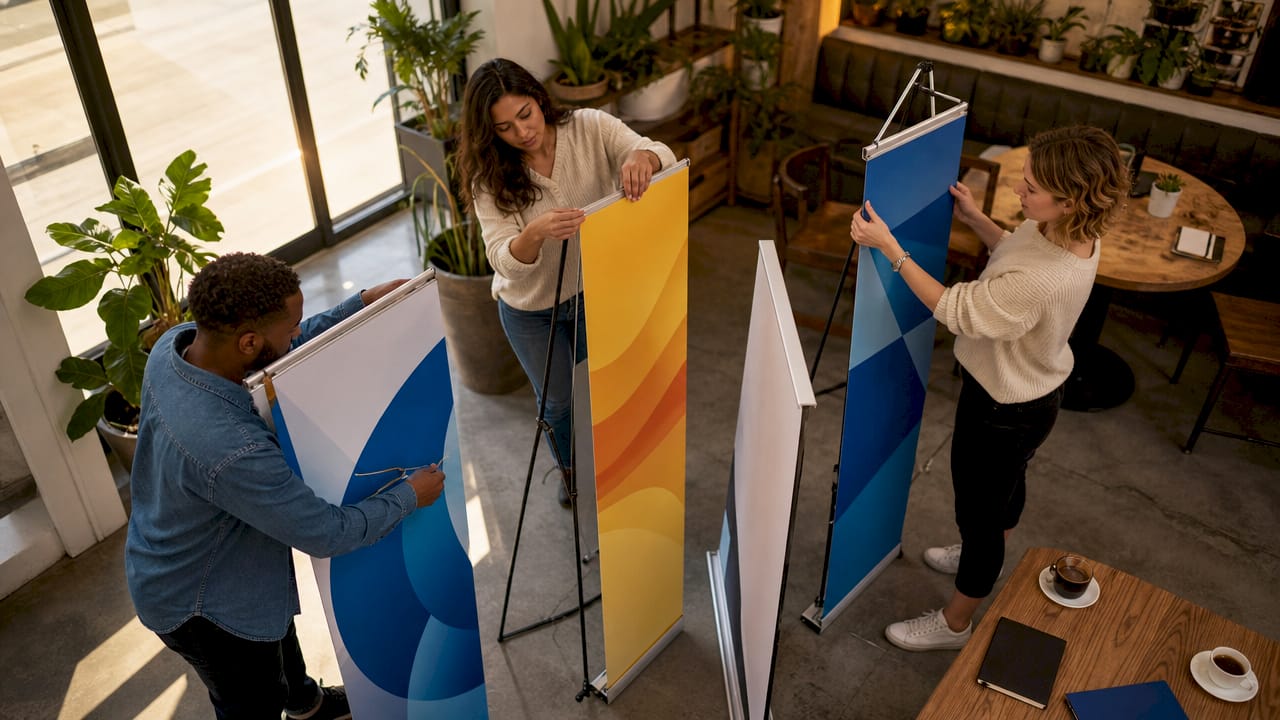
Retractable banners are the most common single-unit display at trade shows. The industry default size is 33 to 33.5 inches wide by 78 to 80 inches tall. That proportion fills vertical space without overwhelming a 10x10 foot booth. Narrower options at 24x62 inches work well for tighter spaces or secondary messaging, while wider formats at 47x80 inches suit exhibitors who want a dominant visual anchor without committing to a full backdrop.
Pop-up and fabric backdrop displays scale to booth width. A 3x3 panel grid produces a display roughly 7.5 feet wide by 7.5 feet tall, which is the standard fit for a 10x10 foot booth. A 4x3 grid expands that to approximately 10 feet wide by 7.5 feet tall, covering the full rear wall of a 10x10 booth or serving as a partial backdrop in a 10x20 space.
Vinyl banners follow a different logic because they are mounted rather than self-supporting. Common trade show vinyl banner dimensions include 4x2 feet, 6x2 feet, 8x4 feet, and 10x5 feet. The horizontal formats work well for hanging above booth entries or along pipe-and-drape systems.
Tension fabric displays at 8x8 feet and 10x10 feet are the premium option for inline booths. They produce a seamless printed surface with no panel seams, which reads better at distance and photographs cleanly for social media.
Tabletop banners are the smallest format, typically running 11x17 inches or 12x20 inches. They sit on counters and tables to communicate product details or pricing at close range.
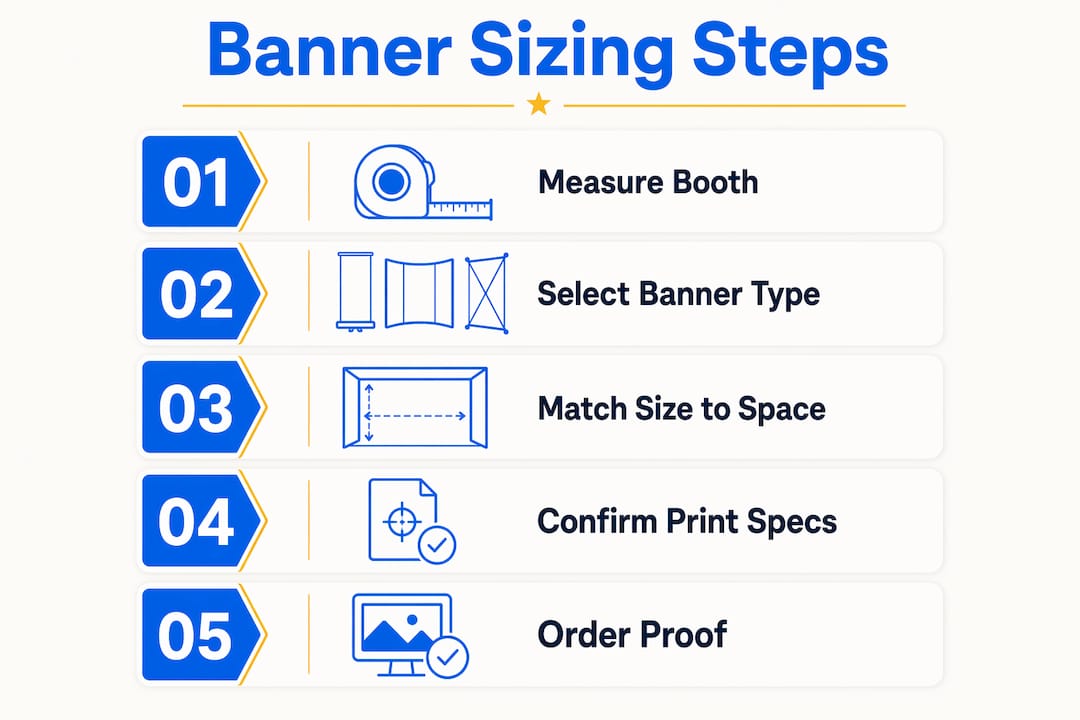
| Banner type | Common sizes | Best use case |
|---|---|---|
| Retractable banner | 33x80 in, 24x62 in, 47x80 in | Standalone displays, booth flanking |
| Pop-up backdrop | 7.5x7.5 ft (3x3), 10x7.5 ft (4x3) | Rear wall coverage, photo backdrops |
| Vinyl banner | 4x2 ft, 6x2 ft, 8x4 ft, 10x5 ft | Hanging displays, pipe-and-drape |
| Tension fabric display | 8x8 ft, 10x10 ft | Inline booths, seamless backdrops |
| Tabletop banner | 11x17 in, 12x20 in | Counter displays, product detail |
How to choose the right banner size for your booth
Selecting the right banner size starts with measuring your booth footprint before you look at any product catalog. The three most common booth configurations at U.S. trade shows are 10x10 feet, 10x20 feet, and 20x20 feet. Each one sets a hard ceiling on how large your backdrop can be and how many standalone banners fit without crowding the space.
For a 10x10 foot booth, a single 7.5x7.5 foot pop-up backdrop or tension fabric display covers the rear wall cleanly. Two retractable banners at 33x80 inches placed at the front corners frame the space without blocking traffic flow. Avoid going wider than 8 feet on any single display in this configuration.
For a 10x20 foot booth, a 10x7.5 foot backdrop fills the rear wall, and you have room for two to four retractable banners along the sides. Vinyl banners at 8x4 feet or 10x5 feet work well suspended from the pipe-and-drape ceiling grid.
Viewing distance is the second variable. Banners viewed from 10 feet or less can carry fine detail and smaller text. Banners viewed from 20 feet or more need larger type, simpler graphics, and greater overall dimensions to remain legible. Outdoor trade shows and open convention floors typically require larger formats because foot traffic passes at greater distances.
- Measure all walls, frames, and poles before ordering to avoid costly reprints
- Match backdrop width to booth width, not just to the display hardware dimensions
- Use horizontal banner formats at 4x2 feet or 6x2 feet for eye-level placements on walls and fences
- Size retractable banners to stand at least 6 inches shorter than the booth ceiling height
- Account for table covers, counters, and product displays when calculating available floor space
Pro Tip: Order a physical proof or request a digital mockup showing your banner at scale within your booth dimensions. Many exhibitors approve artwork without checking proportions against the actual booth, which is the most common cause of mismatched displays.
What print specs matter when sizing trade show banners?
Print artwork specifications and banner size are not separate decisions. They interact directly, and planning them together reduces the risk of cropped logos, blurry graphics, and misaligned borders.
Resolution (DPI) is the first spec to confirm. The recommended DPI for banner printing is 150 DPI for standard trade show banners, 300 DPI for materials viewed at close range such as tabletop displays, and 72 to 100 DPI for large-format banners viewed from a distance of 15 feet or more. A 10x10 foot tension fabric display does not need 300 DPI artwork. Supplying it at that resolution creates unnecessarily large files without improving print quality at viewing distance.
Bleed and safe areas are the second set of specs. Bleed requirements run 3 to 5 mm for smaller banners and increase to 10 mm or more for large-format prints. The safe area, which is the zone where no critical text or logos should appear, sits 20 to 50 mm inside the finished edge. On a 33x80 inch retractable banner, that means keeping your headline and logo at least 1 inch from every edge.
Here is a step-by-step process for preparing print-ready files:
- Confirm the exact finished size of your banner with the printer before building your artwork file
- Set your canvas to the finished dimensions plus bleed on all four sides
- Place all critical content, including text, logos, and contact details, within the safe area boundary
- Set color mode to CMYK, not RGB, to match commercial print output
- Export at the correct DPI for your banner size and intended viewing distance
- Embed all fonts or convert text to outlines to prevent font substitution errors
- Submit a PDF or high-resolution TIFF rather than a JPEG to preserve image quality
Pro Tip: Planning bleed and safe areas at the same time you confirm your banner size prevents the most common production errors. Build your template before you design, not after.
How does banner material affect size selection?
Material choice sets practical limits on how large a banner can be, how it ships, and whether it performs in the environment where it will hang.
| Material | Max practical size | Best environment | Key advantage |
|---|---|---|---|
| Vinyl | Up to 10x20 ft | Outdoor and indoor | Durable, weather-resistant |
| Mesh | Up to 10x20 ft | Outdoor, windy areas | Wind passes through, reduces tear risk |
| Fabric | Up to 10x10 ft typical | Indoor trade shows | Lightweight, wrinkle-resistant |
| Tension fabric | 8x8 ft to 10x10 ft+ | Indoor premium booths | Seamless surface, vibrant color |
Vinyl banners are the most size-flexible material. Standard vinyl banner sizes run from 4x2 feet to 10x5 feet for typical trade show use, but custom vinyl can reach 10x20 feet for large outdoor installations. The material is heavy at larger sizes, which affects shipping weight and setup time.
Mesh banners share the same size range as vinyl but are the correct choice for outdoor venues with wind exposure. The perforated surface allows air to pass through, which reduces the load on grommets and mounting hardware. For indoor trade shows, mesh offers no advantage over fabric or vinyl.
Fabric banners are the preferred material for portable indoor booths. They fold into carry bags, resist wrinkles after unfolding, and produce accurate color reproduction. The practical size limit for a single-piece fabric banner is around 10x10 feet before weight and handling become issues.
Tension fabric displays use a stretch fabric printed graphic over a rigid aluminum frame. The frame determines the size, and the fabric pulls tight to eliminate wrinkles entirely. This format is the best choice for exhibitors who want a polished appearance without visible seams or grommets.
Best practices for trade show display sizing
Consistent sizing decisions across all booth elements create a professional appearance that reinforces brand credibility. Mismatched banner heights, inconsistent proportions, and banners that extend beyond their frames signal poor planning to buyers and prospects walking the floor.
- Confirm all measurements with your booth provider or show organizer before placing any print order
- Coordinate banner sizes with other display elements including tabletop displays, counters, and canopy tents so proportions align visually
- Use standard sizes whenever possible. Custom sizes require manual cutting, extend lead times, and increase cost
- Walk the venue or study the floor plan to identify where foot traffic concentrates, then size banners to be visible from those vantage points
- Keep all critical information, including your brand name, tagline, and contact details, within the safe area margins on every banner
- Test visual impact by printing a scaled version of your design and viewing it from the expected audience distance before approving final production
Pro Tip: If you are exhibiting at multiple shows with different booth sizes, design your banners to work at the smallest booth configuration. A banner sized for a 10x10 booth will always fit. A banner sized for a 20x20 booth will not.
Key takeaways
Selecting the correct banner dimensions requires matching size to booth footprint, viewing distance, material, and print specifications simultaneously.
| Point | Details |
|---|---|
| Industry default retractable size | 33x80 inches fits most 10x10 foot trade show booths without crowding the space. |
| Backdrop sizing by booth width | A 3x3 pop-up grid at 7.5x7.5 ft covers a 10x10 booth rear wall cleanly. |
| DPI by viewing distance | Use 150 DPI for standard banners, 300 DPI for close-view displays, 72 to 100 DPI for large distant formats. |
| Bleed and safe area | Add 3 to 10 mm bleed and keep critical content 20 to 50 mm from all edges. |
| Standard sizes save time and money | Standard formats reduce lead times and eliminate manual cutting costs versus custom dimensions. |
What I have learned from years of trade show banner production
The most consistent mistake I see from exhibitors is treating banner sizing as a last-minute decision. They finalize booth location, design artwork, and only then check whether the dimensions fit the space. By that point, the artwork is built to the wrong proportions and the reprint cost is unavoidable.
The second mistake is ordering custom sizes to save a few inches on one side. Custom dimensions require manual cutting and longer production queues. A standard 33x80 inch retractable banner ships faster and costs less than a 31x76 inch version that does essentially the same job. The savings from custom sizing rarely justify the added lead time, especially when show dates are fixed.
What actually works is building a sizing template for each booth configuration you use regularly. A 10x10 template, a 10x20 template, and a tabletop template cover the majority of trade show scenarios. Each template includes confirmed dimensions, bleed settings, safe area guides, and DPI requirements. When a new show comes up, the artwork team works from a proven template rather than starting from scratch.
The detail most exhibitors overlook is the relationship between material weight and setup time. A 10x20 foot vinyl banner looks impressive on paper. At the show, it takes two people and 20 minutes to hang correctly. A tension fabric display of the same footprint sets up in under 10 minutes with one person. Size and material are the same decision, not two separate ones.
— Printdrill
Custom trade show banners sized for your booth
Printdrill produces custom fabric banners, mesh banners, and retractable displays in both standard and custom dimensions to match any booth configuration.
For exhibitors building a complete booth, the 10x10 tension fabric booth kit and the 10x20 booth display kit include hardware and printed graphics sized to industry standards. Free design assistance is available for every order. Upload your artwork, request a digital proof, and receive your display shipped directly to your location or show site.
FAQ
Q: What is the standard size for a trade show retractable banner?
A: The industry standard for a retractable banner at trade shows is 33 to 33.5 inches wide by 78 to 80 inches tall. This size fits most 10x10 foot booth configurations without blocking traffic or overpowering adjacent displays.
Q: What DPI should I use for trade show banner artwork?
A: Use 150 DPI for standard banners, 300 DPI for tabletop or close-view displays, and 72 to 100 DPI for large-format banners viewed from 15 feet or more. Higher DPI does not improve quality on large-format prints viewed at distance.
Q: How much bleed should a trade show banner have?
A: Bleed should be 3 to 5 mm for smaller banners and at least 10 mm for large-format prints. Keep all critical text and logos at least 20 to 50 mm inside the finished edge to prevent cropping during production.
Q: What size backdrop fits a 10x10 trade show booth?
A: A pop-up or tension fabric backdrop at 7.5x7.5 feet, produced from a 3x3 panel grid, covers the rear wall of a standard 10x10 foot booth. A 4x3 grid at 10x7.5 feet fills the full width for exhibitors who want complete rear wall coverage.
Q: Should I use standard or custom banner sizes for trade shows?
A: Standard sizes are the better choice for most exhibitors. They reduce lead times, eliminate manual cutting costs, and fit the most common display hardware configurations. Custom sizes are justified only when booth dimensions or display frames fall outside standard ranges.
