

The Role of Banners in Event Marketing That Works
TL;DR:
- Event banners are large-format printed displays that boost brand recognition and guide attendee behavior at events. They function as physical communication tools that remain effective throughout an event and beyond.
Event banners are defined as large-format printed displays that create immediate brand recognition and guide attendee behavior at trade shows, conferences, and promotional events. The role of banners in event marketing goes far beyond decoration. They function as physical communication tools that increase brand recall long after an event ends. For marketing professionals and event planners, banners are one of the few assets that work continuously throughout an event without requiring staff attention. Printdrill produces custom vinyl, fabric, and mesh banners built specifically for this kind of sustained, high-visibility performance.
How do banners create brand visibility and attendee engagement at events?
Large-format printed banners work because of the psychology of scale. Physical banners register as more significant than digital ads in crowded venues because the human brain processes large physical objects as inherently important. A 6-foot retractable banner stand at a trade show entrance triggers a faster cognitive response than a screen running a rotating ad carousel. That difference in attention speed matters when you have 3 seconds to stop a walking attendee.
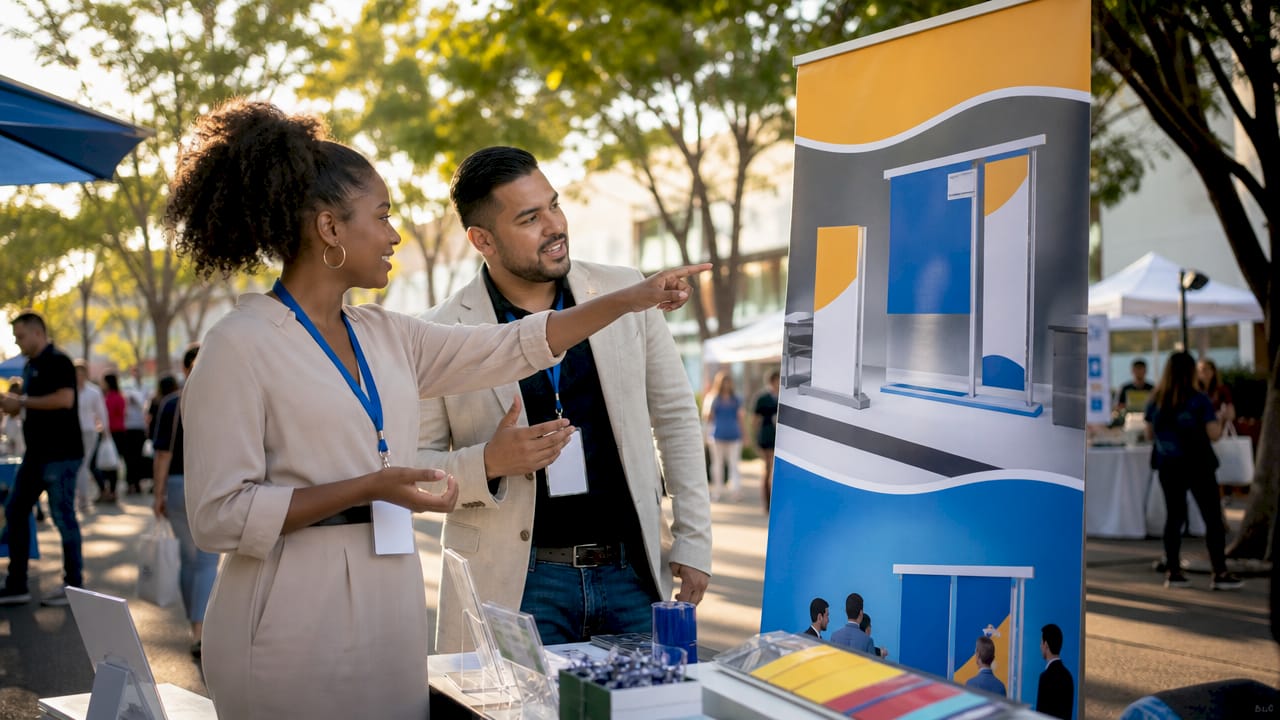
Banners also solve a practical problem that every event planner faces. Staff get busy, lines form, and attendees wander without direction. Roller banners answer key questions like “What is this brand?” and “What should I do next?” during those critical first 10–15 seconds when no one is available to greet a visitor. That function alone justifies the investment.
Different event spaces call for different banner formats. Pull-up retractable stands work well in tight indoor conference spaces because they set up in under a minute and take up minimal floor space. Mesh banners handle outdoor festivals and open-air markets because their perforated surface reduces wind resistance. Fabric banners suit premium indoor environments like corporate galas or product launches because the material produces richer color depth and a softer visual finish than vinyl.
- Pull-up/retractable stands: Best for indoor trade shows, conferences, and retail pop-ups
- Mesh banners: Designed for outdoor events with wind exposure
- Fabric banners: Preferred for premium indoor settings requiring sharp, vibrant color
- Vinyl banners: Durable, weather-resistant option for general outdoor and indoor use
Pro Tip: Place a pull-up banner within 5 feet of your booth entrance at eye level. Attendees make approach decisions in under 3 seconds, and a banner at that position captures attention before a person even slows down.
What are best practices for banner design, messaging, and placement?
Banner design fails most often because of clutter. Simple, focused messaging improves visitor engagement and lead capture outcomes. One strong headline, one supporting line, and one clear call-to-action is the correct structure. Adding a logo, three bullet points, a tagline, and a website URL to the same banner produces visual noise that attendees ignore.
Placement follows a three-stage logic tied to the visitor journey. Think of it as modular banner infrastructure, where each banner serves a specific function at a specific point in the attendee’s path through your space.
- Entry point banners orient visitors immediately. They answer “Who is this?” and “Is this relevant to me?” before a person commits to stopping.
- Aisle-facing banners attract attention from a distance. These need bold color contrast and a single short headline readable from 15–20 feet away.
- Booth interior banners act as silent salespeople when staff are occupied. They reinforce product benefits, pricing tiers, or service categories without requiring conversation.
- Photo backdrop banners create a branded content zone. Step and repeat displays with your logo repeated across the surface generate user photos that carry your brand into social media feeds organically.
QR codes printed directly on banners add a measurable layer to this physical infrastructure. A QR code linked to a landing page, product demo video, or event-specific offer converts a static display into a trackable touchpoint. You can measure scan volume, time of day, and conversion rate from that single printed element.
Pro Tip: Use a URL shortener with tracking parameters behind your QR code. This lets you compare scan rates across different banner positions at the same event and refine placement at your next show.
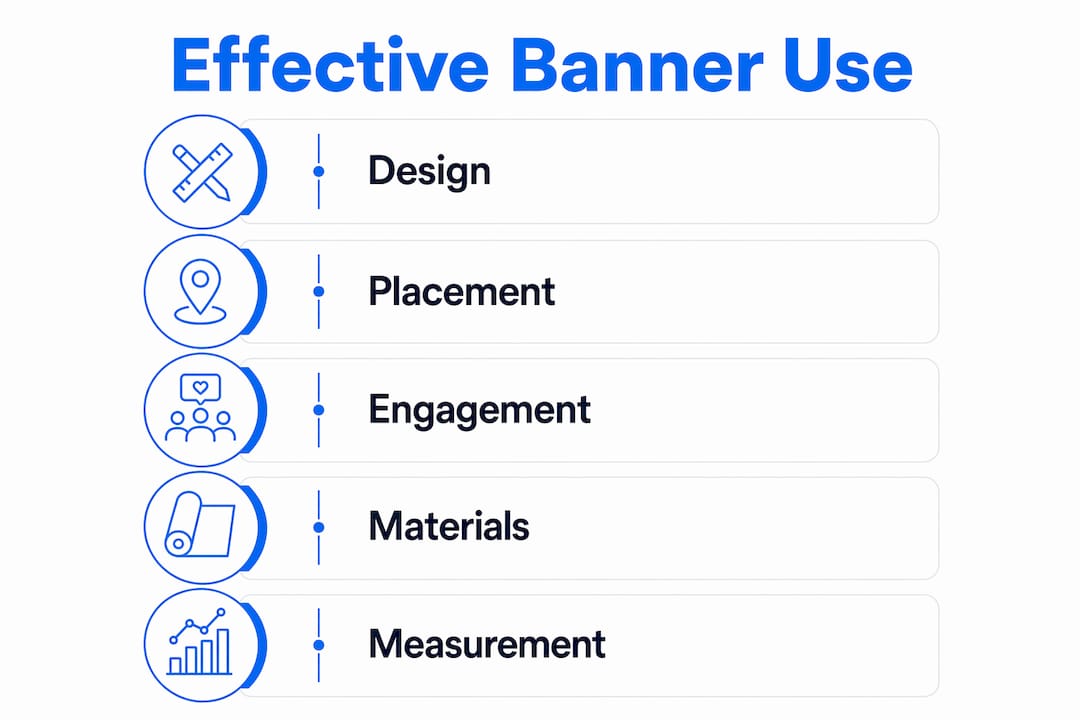
For trade show banner sizing, the standard retractable stand prints at 33 inches wide by 80 inches tall. That dimension is readable from 10–12 feet in a standard conference hall. Larger format banners, such as 4-foot by 8-foot vinyl displays, work for booth back walls where you need to fill vertical space and create a branded backdrop.
How do different banner types and materials impact event outcomes?
Material choice directly affects both appearance and total cost over time. High-quality materials increase longevity and reduce replacement frequency, which lowers the real cost per event use. A fabric banner that lasts 50 events costs less per use than a vinyl banner replaced after 10.
| Banner type | Best use case | Key material advantage | Durability |
|---|---|---|---|
| Vinyl | Outdoor events, general use | Weather-resistant, low cost | High |
| Fabric | Indoor premium events | Rich color, wrinkle-resistant | Medium-high |
| Mesh | Outdoor windy environments | Wind-resistant perforated surface | High |
| Retractable stand | Trade shows, conferences | Portable, fast setup | High with hardware |
Retractable banner stands deserve special attention for event planners managing multiple shows per year. The hardware unit, meaning the base and the cassette mechanism, lasts for years. Only the printed graphic needs replacing when messaging changes. Interchangeable graphic panels reduce cost over time and give your marketing program the flexibility to update messaging between events without buying new hardware.
Fade-resistant inks matter for outdoor banners exposed to direct sunlight. UV-resistant printing preserves color accuracy through multiple outdoor seasons. For indoor fabric banners, dye-sublimation printing produces the sharpest color gradients and the most accurate brand color matching. Printdrill uses commercial-grade printing technology across its banner catalog to meet these standards consistently.
A double-sided banner stand doubles your display surface in the same floor footprint. This format works well in aisle positions where foot traffic passes from both directions, giving you two audience-facing panels from a single placement.
How can banners support measurable engagement and post-event follow-up?
Banners generate measurable data when designed with tracking elements. QR codes and event hashtags convert static displays into interactive engagement tools that extend reach beyond the physical event space. A hashtag printed on a photo backdrop banner encourages attendees to post branded photos, which creates organic social content you did not pay to produce.
The measurable benefits of banners in promotional events include:
- QR code scans: Track volume and conversion rate per banner position
- Hashtag mentions: Monitor social reach generated by banner-prompted photo sharing
- Lead capture support: Banners displaying a clear offer or call-to-action increase the number of visitors who approach staff with intent
- Return visit signals: Banner stands help attendees navigate complex event layouts, which reduces confusion and increases the likelihood of return visits to your booth
Post-event follow-up also benefits from banner-driven awareness. Attendees who saw your banner multiple times during an event are more likely to recognize your brand in a follow-up email or retargeting ad. The physical impression creates a memory anchor that digital-only campaigns cannot replicate. That recall effect is why event banners support brand awareness beyond the event itself, not just during it.
For planners managing custom event banner orders, building a reusable banner kit with interchangeable graphics reduces per-event costs while maintaining consistent brand presentation across multiple shows.
Key Takeaways
Banners are the most cost-effective physical marketing asset at events when placed correctly, designed simply, and built from durable materials that last across multiple shows.
| Point | Details |
|---|---|
| Placement drives results | Position banners at entry points, aisles, and booth interiors to guide attendees at each stage. |
| Simple design converts better | One headline, one call-to-action, and a clear logo outperform cluttered multi-message layouts. |
| Material choice affects total cost | Fabric and retractable systems with interchangeable graphics reduce long-term replacement costs. |
| QR codes make banners measurable | Printed QR codes and hashtags connect physical displays to trackable digital campaigns. |
| Banners work when staff cannot | Strategically placed banners answer visitor questions and maintain brand presence independently. |
What event planners get wrong about banner strategy
Most event planners treat banners as the last item on the production checklist. They order them after the booth layout is finalized, which means placement becomes an afterthought rather than a planned element. That sequence produces weak results.
The planners who get the most from their banner investment think about placement before they finalize the booth design. They map the attendee path first, then identify the three or four moments where a banner can intercept attention or answer a question. That approach turns banners from background decoration into active parts of the event experience.
The other mistake I see consistently is over-investing in elaborate booth structures while under-investing in banner quality. A high-quality fabric banner with sharp color and clean typography communicates professionalism faster than an expensive booth frame with mediocre graphics. Attendees read the banner before they read anything else. The print quality is the first signal about your brand’s standards.
Simplicity is not a design compromise. It is the correct strategy for an environment where attendees are moving, distracted, and processing dozens of competing visual signals simultaneously. The brands that win at trade shows are the ones whose banners communicate one clear idea in under two seconds.
Printdrill custom banners for your next event
Printdrill offers custom fabric banners and custom mesh banners built for the demands of trade shows, outdoor festivals, and promotional events. Both product lines use commercial-grade materials with UV-resistant inks for lasting color accuracy across multiple events.
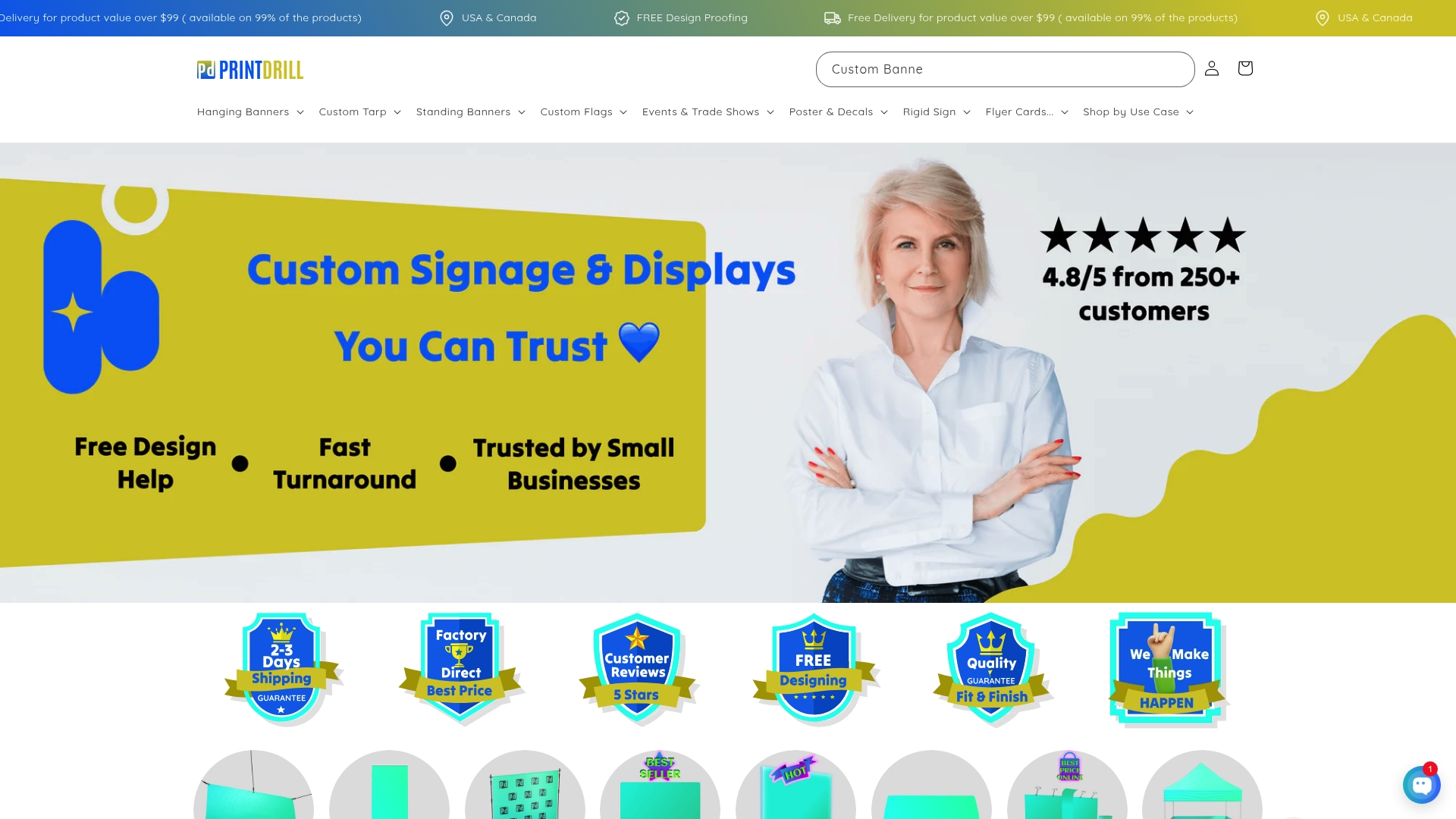
Every order includes free design assistance and a digital proof before production. Planners who need a complete booth presence can pair banners with Printdrill’s retractable stands, step and repeat displays, and canopy tents. Fast nationwide shipping means you can order with confidence even on tighter event timelines. Visit Printdrill to configure your banner order with the size, material, and finish that fits your next event.
FAQ
Q: What is the role of banners in event marketing?
A: Banners are physical marketing displays that create immediate brand recognition, guide attendee behavior, and maintain brand presence when staff are unavailable. They function as constant visual anchors throughout the event.
Q: How do banners enhance engagement at trade shows?
A: Banners placed at entry points and high-traffic zones answer visitor questions instantly and direct foot traffic toward your booth. Adding QR codes and hashtags converts them into measurable engagement tools.
Q: What banner material works best for outdoor events?
A: Mesh banners are the best choice for outdoor events because their perforated surface reduces wind resistance. Vinyl banners also perform well outdoors due to their weather-resistant construction.
Q: How many banners does an event booth need?
A: Most booths benefit from three banner positions: one at the entry point, one facing the aisle, and one inside the booth as a product or service reference. Larger booths may add a photo backdrop banner for social content generation.
Q: What makes a banner design effective at events?
A: Effective banner design uses one headline, one supporting message, and one clear call-to-action. Simple, focused messaging significantly improves visitor engagement and lead capture outcomes compared to cluttered layouts.
