

Portable Booth Display Options for Event Coordinators
TL;DR:
- Portable booth displays offer quick assembly and efficient transport, ideal for exhibitors attending multiple trade shows annually. They include pop-up frames, fabric tension displays, and retractable banners, all designed for modularity, durability, and visual impact across various booth sizes and distances. Choosing the right system depends on event frequency, space, budget, and brand messaging needs to maximize effectiveness and reduce logistics costs.
Portable booth display options are compact, easy-to-assemble exhibit systems designed to deliver strong brand presence at trade shows while allowing effortless transport between events. The industry standard for these systems, including pop-up frames and fabric tension displays, is a setup time under 30 minutes with packing into one or two cases. That efficiency makes them the go-to choice for event coordinators attending three or more shows annually. Printdrill produces a full range of these systems, from tension fabric booth kits to retractable banner stands, built for consistent performance across repeated use. Choosing the right format depends on event size, booth footprint, budget, and how your brand needs to communicate at multiple viewing distances.
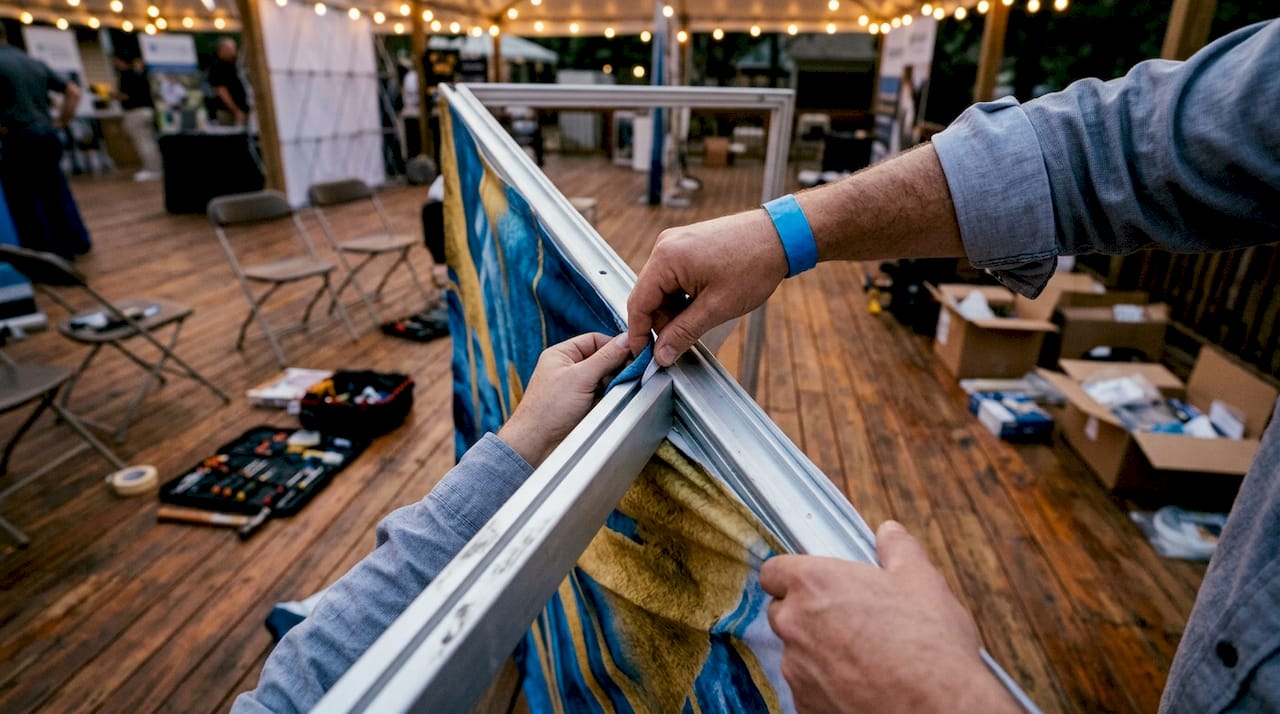
1. What are the top lightweight portable booth displays for frequent exhibitors?
Pop-up frame booths and fabric tension displays are the best portable booth display options for exhibitors attending three or more shows per year. Both systems pack into one or two cases and assemble without tools in under 30 minutes. That combination of speed and simplicity reduces labor costs and setup stress at every event.
Fabric tension displays use a lightweight aluminum frame with a stretch fabric graphic that zips or clips into place. The result is a wrinkle-resistant, sleek visual surface that looks polished without requiring professional installation. These systems are increasingly popular because they balance low weight with high visual impact.
Pop-up frame booths use an accordion-style frame that expands quickly and supports large-format printed panels. They work well in 10x10 and 10x20 configurations and hold their shape reliably across dozens of shows.
Key advantages of lightweight exhibit options for frequent use:
- Tool-free assembly in under 30 minutes
- Consistent graphic quality across repeated setups
- Modular components that replace individually if damaged
- Compact cases that fit in standard cargo vehicles
- Fabric graphics that resist creasing during transport
Pro Tip: Order a second set of graphics for your most-used display. Swapping graphics between events costs far less than buying a new system, and it lets you tailor messaging to each show without reprinting the full booth.
2. How retractable banner stands and tabletop displays work in small spaces
Retractable banner stands are the most affordable and portable display solution for small booth footprints. They set up quickly and deliver strong visibility at a fraction of the cost of a full booth system. For coordinators managing tight budgets or limited floor space, they are the most practical starting point.
A standard retractable stand holds a printed graphic that rolls up into a base unit for transport. Setup takes under two minutes. Tabletop displays follow the same principle but sit on a table surface, making them ideal for conference tables, registration desks, and small exhibit spaces.
Benefits of retractable banners and tabletop formats include:
- Double-sided printing to target different audience segments from one unit
- Effective use in corner booths where two-sided visibility matters
- Easy repositioning within a booth layout during the event
- Low shipping weight, which reduces freight costs for multi-city tours
- Compatibility with larger booth systems as supplemental signage
Retractable stands work best when paired with a larger backdrop or tension fabric display. A single banner stand placed at the front of a 10x10 booth draws foot traffic while the main display communicates the full brand story behind it. That layered approach maximizes messaging without requiring a larger footprint.
3. How to choose the right portable booth display based on event size, budget, and brand goals
The right portable display solution depends on three factors: how often you exhibit, how large your booth space is, and what your brand needs to communicate. Matching these factors to the correct format prevents overspending and under-delivering.
Step 1: Assess your event frequency. Exhibitors attending five or more major shows per year benefit from custom trade show displays that offer a unique visual identity. Exhibitors attending fewer shows get better value from portable systems that reuse graphics across events.
Step 2: Match the display to your booth size. Modular portable booths scale from 10x10 to larger configurations without requiring a separate purchase for each size. That flexibility is critical for coordinators who exhibit in varied venue spaces throughout the year.
Step 3: Plan for three viewing distances. The most common design mistake is failing to plan for three distinct viewing distances: long-distance for logos, mid-distance for value propositions, and close-up for detailed information like brochures and QR codes. Each layer of your display should serve one of these distances without competing with the others.
Step 4: Set a realistic budget range. Retractable banner stands sit at the affordable end of the spectrum. Full tension fabric booth kits with racks represent a mid-range investment. Custom-built permanent structures cost significantly more and require professional installation. Most event coordinators find that a tension fabric kit covers 80% of their needs at a fraction of the cost of a custom build.
Step 5: Factor in logistics costs. Shipping, storage, and setup labor are real costs that most coordinators underestimate. A lighter, more compact system often saves more money in logistics than it costs in upfront price. Prioritize systems that fit in standard cases and require no tools.
Pro Tip: Rent a 10x20 space but use a 10x10 display kit with open floor space in front. Open space signals confidence and invites attendees in. A cramped booth filled with displays often repels foot traffic.
4. What features should event coordinators look for in portable booth displays?
High-quality graphics attract attendees and increase foot traffic when designed with brand consistency and clear visual hierarchy. The display format you choose must support that graphic quality without adding unnecessary weight or complexity.
The table below outlines the key features to evaluate when selecting a portable exhibit system.
| Feature | What to look for |
|---|---|
| Graphic quality | Fabric tension systems deliver wrinkle-resistant, vivid prints |
| Setup time | Tool-free systems assemble in under 30 minutes |
| Modularity | Frames that scale between 10x10 and 10x20 without new hardware |
| Durability | Aluminum frames with replaceable graphic panels |
| Outdoor suitability | Weather-resistant materials and weighted bases for canopy tents |
| Digital integration | Open space or built-in shelving for tablets, kiosks, and QR code signage |
Modularity is the feature most coordinators overlook during purchase. A system that adjusts to different booth sizes eliminates the need to buy separate displays for different events. That single decision can cut long-term display costs significantly.
Digital integration is the next priority. Booths that combine printed fabric backdrops with tablet kiosks, QR codes, or LED lighting consistently outperform static-only setups in attendee engagement. Plan your display layout to include a surface or stand for at least one digital touchpoint. A well-designed booth layout accounts for this from the start, not as an afterthought.
Weather resistance matters for outdoor events. Canopy tents with weighted bases and mesh banner panels handle wind and rain without losing structural integrity. If your event calendar includes outdoor markets, festivals, or corporate activations, prioritize systems rated for outdoor use.
Key takeaways
The most effective portable booth display strategy combines a modular fabric tension system for the main backdrop, retractable banner stands for supplemental messaging, and a layout planned for three distinct viewing distances.
| Point | Details |
|---|---|
| Setup speed matters | Choose tool-free systems that assemble in under 30 minutes to reduce event-day stress. |
| Plan for three distances | Design graphics for long, mid, and close-up viewing to maximize communication at every range. |
| Modularity saves money | Scalable frames eliminate the need to buy separate displays for different booth sizes. |
| Retractable stands add value | Double-sided banner stands maximize messaging in corner and small-footprint booths. |
| Fabric tension outperforms | Wrinkle-resistant fabric graphics deliver a polished look with minimal logistics complexity. |
What I’ve learned about portability versus brand impact
After working with exhibitors across dozens of event formats, one pattern stands out clearly. Coordinators consistently overload their booths with too many display elements and underinvest in graphic quality. The result is a busy booth that attendees walk past rather than into.
The fix is not a bigger display. It is better visual hierarchy. A single large fabric tension backdrop with a clear logo at the top, a value proposition at eye level, and a QR code or brochure rack at arm’s reach outperforms a booth packed with six banner stands and three tabletop displays. Less surface area, used correctly, communicates more.
The three-distance rule is the most practical framework I have seen for solving this problem. Design your long-distance element, your logo and brand color, to be readable from 30 feet. Design your mid-distance element for 10 feet. Design your close-up element for arm’s reach. When those three layers work together without competing, foot traffic increases and conversations start faster.
Fabric tension systems earn their cost because they hold that visual hierarchy reliably across repeated setups. A vinyl banner that creases in transit loses graphic impact. A fabric system that zips onto a frame looks the same at show 12 as it did at show one. That consistency is worth paying for, especially for brands that depend on trade show displays for a significant share of their annual lead generation.
Printdrill’s portable booth display products for trade shows
Printdrill offers a direct path from display selection to production for event coordinators who need reliable, fast-turnaround exhibit solutions.
The custom fabric banner line delivers lightweight, wrinkle-resistant graphics built for repeated use across indoor and outdoor events. For coordinators who need a complete booth system, the 10x20 tension fabric booth kit includes the frame, graphics, and racks in one package, ready to ship nationwide. Outdoor events are covered by the custom mesh banner range, which uses outdoor-grade materials rated for wind and weather. Free design assistance is available for all orders, and digital proofs are provided before production begins.
FAQ
What is the fastest portable booth display to set up?
Fabric tension displays and retractable banner stands are the fastest options. Fabric tension systems assemble in under 30 minutes, while retractable stands set up in under two minutes.
How many banner stands do I need for a 10x10 booth?
One to two retractable banner stands complement a 10x10 booth effectively. Place one at the front for foot traffic and one at the side for corner visibility.
Are portable booth displays suitable for outdoor events?
Yes, when built with weather-resistant materials. Canopy tents, mesh banners, and weighted base systems handle outdoor conditions reliably.
What is the difference between a pop-up booth and a tension fabric display?
A pop-up booth uses an accordion frame with printed panels. A tension fabric display uses a stretch fabric graphic that zips onto an aluminum frame for a smoother, wrinkle-resistant finish.
How often should I replace portable booth display graphics?
Replace graphics when colors fade, fabric shows wear, or your brand messaging changes. High-quality fabric graphics used at three to five shows per year typically last two to three years before replacement is needed.
Recommended
- Trade Show Portable Counter Podium | Custom Event Display Table – PRINTDRILL
- 10x10 Portable Trade Show Booth Kit - Tension Fabric Booth Hub – PRINTDRILL
- 10x20 Tension Fabric Trade Show Booth Kit - Portable 20 ft Booth – PRINTDRILL
- 10x20 Custom Tension Fabric Trade Show Booth Kit - Display with Racks – PRINTDRILL
