

How to Choose Yard Signs for Local Events
Choosing yard signs for local events means selecting the right size, material, design, and quantity to maximize visibility while staying within budget. The standard format for event signage is the corrugated plastic yard sign, mounted on wire stakes, printed with UV-cured inks. Four key decisions drive every successful sign order: size relative to viewing distance, material durability, design clarity, and quantity coverage. Get these right and your signs do real work. Get them wrong and you spend money on signs nobody reads.
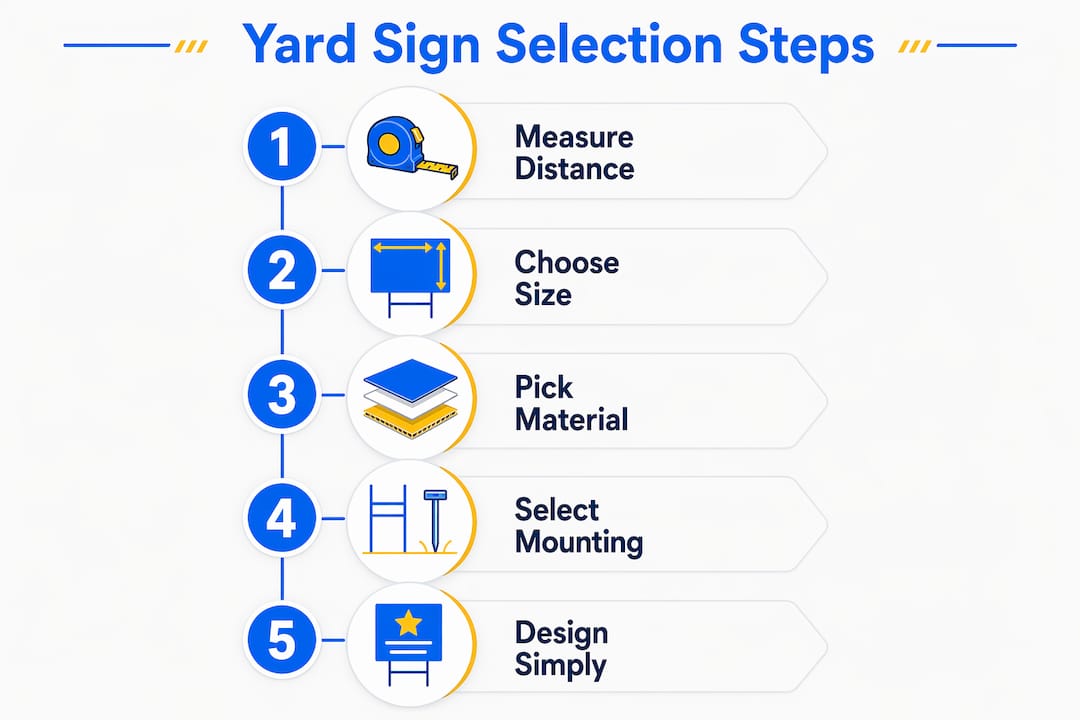
How to choose yard signs for local events by size
Yard sign size depends primarily on viewing distance and traffic speed, not on design preference or brand identity. That single fact eliminates most sizing mistakes before they happen.
The 18x24 inch size is the right choice for 90% of applications. It fits standard stakes, stays affordable for bulk orders, and delivers clear visibility up to about 70 feet. Use it for neighborhood entrances, residential streets, parking lot edges, and any location where foot traffic or slow-moving vehicles are the primary audience.
The 24x36 inch size is built for high-traffic roads and busy intersections where drivers pass at 35 mph or faster. These signs are visible 100 feet out or more, which gives drivers enough time to read and react. The trade-off is cost and portability. A 24x36 sign costs roughly twice as much as an 18x24, and transporting 50 of them is a different logistical challenge than transporting 50 smaller signs.
A useful rule for font sizing: every inch of letter height delivers approximately 10 feet of readable distance. A 3-inch headline on an 18x24 sign reads clearly at 30 feet. Bump that to 5 inches and you reach 50 feet. This math should drive your layout decisions before you finalize any design.
| Size | Best use | Visibility range |
|---|---|---|
| 18x24 inches | Residential streets, parking lots, slow traffic | Up to 70 feet |
| 24x36 inches | Main roads, busy intersections, fast traffic | 100+ feet |
| 12x18 inches | Indoor wayfinding, close-range directional signs | Up to 30 feet |
Pro Tip: Check your city or county ordinances before ordering. Many municipalities restrict sign dimensions in public right-of-way. Mountain View, CA, for example, prohibits signs in the right-of-way entirely and requires removal within 10 days after an event.
What materials and mounting options work best outdoors
5mm corrugated plastic, sold under the trade name Coroplast, is the industry standard for outdoor event yard signs. It is waterproof, UV-protected, and holds up through rain, wind, and direct sun without warping or fading. For events running one to four weeks, no other material at this price point competes.
Mounting options break into three practical categories:
-
Wire stakes are the default for most grass and soft-ground installations. They push into the ground by hand, require no tools, and pull out cleanly after the event. Standard stakes fit 18x24 signs with vertically oriented flutes.
-
Screw-in stakes work better in compacted soil or hard ground where wire stakes bend or fail to seat properly. They take more time to install but hold significantly better in high-wind conditions.
-
Grommets are the right choice when you need to hang signs on fences, zip-tie them to poles, or attach them to temporary structures. Grommets add minimal cost and open up placement options that stakes cannot reach.
One detail most planners overlook: flute orientation on corrugated plastic signs must align vertically for stakes to insert correctly. Horizontal flutes block the stake channels and make installation impossible. Confirm this with your printer before production, especially on landscape-format signs.
Pro Tip: In areas with consistent wind above 15 mph, use screw-in stakes and consider ordering 10% extra signs as replacements. Wind damage is the most common cause of mid-event sign loss.
How should you design yard signs for fast comprehension
Effective yard sign design operates on a 3-second rule. A person driving or walking past your sign has roughly three seconds to read it. Every design decision should serve that constraint.
The layout that works consistently for local event signage follows a three-tier hierarchy. The event name goes at the top in the largest text on the sign. The date and location go in the middle at roughly half the size of the headline. A call to action or directional instruction goes at the bottom in the smallest of the three tiers. Nothing else belongs on the sign.
High-contrast color combinations are not optional. Black text on a yellow background, white text on a dark blue background, and black text on white are the three most readable combinations at distance. Avoid red text on dark backgrounds, light gray on white, and any combination where the text and background share similar brightness levels. Color contrast is what makes a sign readable in direct sunlight, at dusk, and from a moving vehicle.
Common design mistakes that reduce readability:
-
More than three lines of text on an 18x24 sign
-
Font sizes below 2 inches for any text meant to be read from a vehicle
-
Decorative or script fonts that sacrifice legibility for style
-
Logos or graphics that compete with the primary message for visual space
-
QR codes placed on signs meant to be read from a distance
Directional arrows and simple iconography work well for wayfinding signs. A bold arrow pointing left communicates faster than any text instruction. For multi-entrance events or festivals spread across several blocks, a set of wayfinding signs with arrows and a short location label outperforms any single large sign placed at the main entrance.
How to estimate quantity and plan placement for full event coverage
Quantity planning starts with a site map, not a budget. Walk or drive the routes attendees will take from major roads to the event entrance and count every decision point: turns, intersections, parking lot entrances, and venue entry points. Each decision point needs at least one sign.
A practical framework for most local events:
-
Count every turn between the nearest major road and the event entrance. Each turn requires one sign placed before the turn, visible to approaching traffic.
-
Add one sign at each parking lot or venue entrance.
-
Place headline signs at the two or three highest-traffic intersections within a half-mile of the venue.
-
Add one sign at each neighborhood entrance if the event draws from surrounding residential areas.
-
Add a 10 to 15% buffer to your total for replacements, layout adjustments, and signs that get removed by property owners or municipal crews.
Small community events typically need 10 to 20 signs. Larger festivals covering multiple blocks or drawing from across a city can require 50 to 100 or more. The buffer matters more at larger events because the cost of running out of directional signs mid-event is measured in confused attendees and missed attendance.
Single-sided signs work for locations where traffic approaches from one direction only. Double-sided signs cost more but are worth the investment at corners, medians, and intersections where traffic arrives from multiple directions. A double-sided sign at a busy corner effectively replaces two single-sided signs and requires only one stake installation.
Local ordinances frequently restrict sign placement in public right-of-way, require removal within specific timeframes after an event, and limit sign dimensions. Confirm the rules for every municipality where you plan to install signs before you order. Violations result in sign removal and sometimes fines, both of which undermine your event promotion effort.
Key takeaways
Choosing effective yard signs for local events requires matching size to viewing distance, selecting durable corrugated plastic with correct stake orientation, designing for a 3-second read, and planning quantity from a site map with a replacement buffer.
| Point | Details |
|---|---|
| Size drives readability | Use 18x24 for slow traffic up to 70 feet; use 24x36 for fast roads at 100+ feet. |
| Material standard | 4mm corrugated plastic with vertical flutes and wire stakes covers most outdoor event needs. |
| Design for 3 seconds | Limit text to event name, date/location, and one call to action with high-contrast colors. |
| Plan quantity from a site map | Count every turn and entrance, then add 10 to 15% extra for replacements. |
| Check local rules first | Ordinances restrict placement, size, and removal timelines in many municipalities. |
What experience with event signage actually teaches you
After working with event organizers across community festivals, school fundraisers, and neighborhood block parties, the pattern that stands out most is this: planners consistently underestimate quantity and overestimate how much text a sign can carry.
The instinct to include a website URL, a phone number, a sponsor logo, and a tagline on a single 18x24 sign is understandable. You want to communicate everything. But a sign that tries to say everything communicates nothing to someone passing at 30 mph. The events with the best foot traffic are almost always the ones with the simplest signs placed at the most decision points.
Double-sided signs at busy corners are the single highest-return upgrade most planners skip because of cost. A corner with two-way traffic and a single-sided sign is a missed opportunity on every approach that cannot see the sign face. The incremental cost of double-sided printing pays for itself in visibility.
Confirming local sign rules early is not a bureaucratic formality. It is logistics. Finding out two days before your event that a key intersection prohibits temporary signage forces last-minute rerouting of your entire placement plan. Check the rules for every location before you order, not after.
One more practical note: assign someone specific to check signs the morning of the event. Wind, overnight rain, and early-morning municipal crews all remove signs before attendees arrive. A 30-minute check-and-replace run on event morning is standard practice for well-run events.
Get custom yard signs for your next event from PrintDrill
PrintDrill produces custom yard signs in corrugated plastic with UV-cured inks, standard stakes, and fast nationwide turnaround. Sizes include 18x24 and 24x36, with single-sided and double-sided options available.
Free design support is available for planners who need help with layout, contrast, or sizing before production. For events that need more than yard signs, Printdrill also offers custom mesh banners for fence lines and outdoor perimeters, and metal A-frame signs for entrance and wayfinding placements. Visit PrintDrill to configure your order, upload artwork, and get a quote.
FAQ
Q: What is the standard yard sign size for local events?
A: The standard size is 18x24 inches, which fits standard stakes and is readable up to 70 feet. Use 24x36 inches for high-traffic roads where visibility beyond 100 feet is needed.
Q: What material is best for outdoor event yard signs?
A: 5mm corrugated plastic is the standard material for outdoor event signs. It is waterproof, UV-resistant, and works with wire stakes for easy installation and removal.
Q: How many yard signs do I need for a local event?
A: Quantity depends on the number of turns, entrances, and decision points on the route to your event. Small events typically need 10 to 20 signs; larger events may need 50 to 100 or more, plus a 10 to 15% buffer for replacements.
Q: When should I use double-sided yard signs?
A: Use double-sided signs at corners, medians, and intersections where traffic approaches from more than one direction. They cost more than single-sided signs but eliminate the need for two separate sign installations at the same location.
Q: Do I need a permit to place yard signs for a local event?
A: Permit requirements vary by municipality. Many cities restrict sign placement in public right-of-way and require removal within a set number of days after the event. Check local ordinances for every location before installing signs.
