

How to Choose a Retractable Banner Stand in 2026
TL;DR:
- A retractable banner stand is a portable display unit with a graphic that rolls into a base cassette for easy storage and quick setup. Choosing the appropriate stand type, stability features, and graphic materials based on event environment and usage frequency ensures a polished brand presentation. Investing in high-quality, durable hardware and planning setup and transport logistics can prevent common display failures and maximize long-term effectiveness.
A retractable banner stand is a self-contained display unit where the printed graphic rolls up into a base cassette for storage and deploys in seconds by extending a support pole. Choosing the right one directly determines whether your brand looks polished or forgettable at your next trade show, conference, or retail event. The roll-up banner stand, as it is formally known in the display industry, comes in several distinct formats, each with real tradeoffs in stability, portability, and graphic quality. This guide covers every factor you need to choose retractable banner stand options that match your event environment, usage frequency, and brand standards.
What are the types of retractable banner stands and how do they compare?
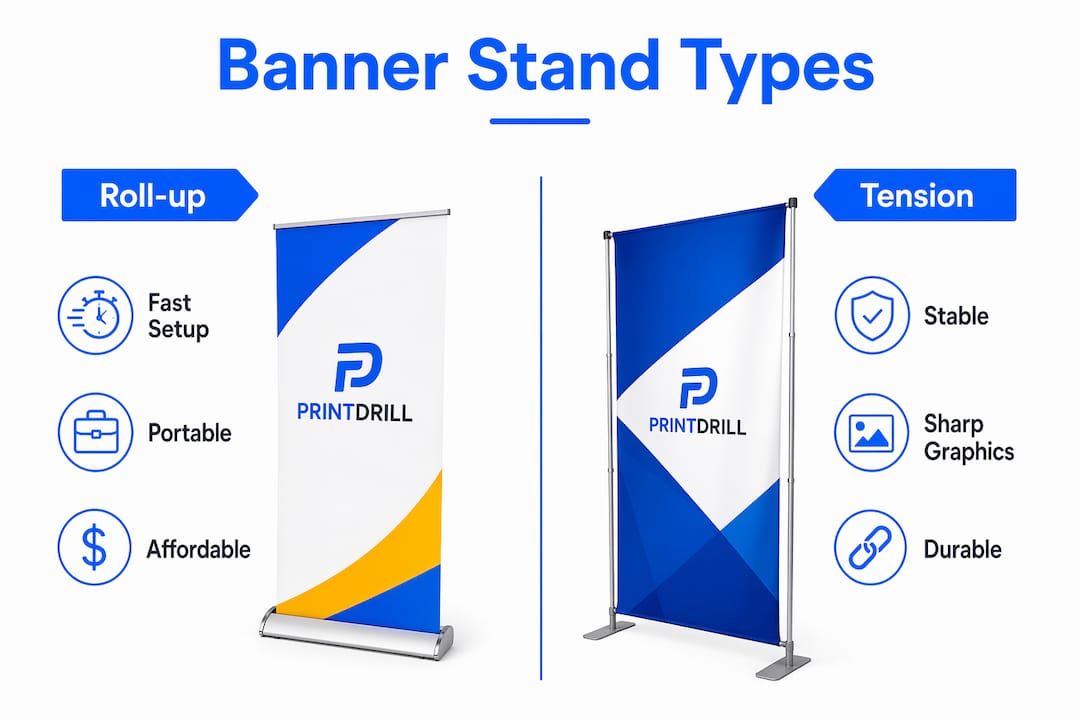
Roll-up retractable stands offer quick setup but vary significantly in mechanism quality, which directly affects both durability and whether the graphic stays flat or develops a curl over time. Understanding the three main formats is the fastest way to narrow your options.
Roll-up (retractable) stands use a spring-loaded cassette base. The graphic attaches to a top rail, and you pull it upward while extending a telescoping pole behind it. Setup takes under two minutes. The tradeoff is that lower-quality mechanisms wear out faster and can cause the graphic to curl at the bottom after repeated use.
Tension stands hold the graphic taut between a top and bottom rail using bungee-style poles. They produce sharper, flatter graphics than most roll-up units, but assembly takes longer. These work well for permanent installations or high-visibility booth backdrops where graphic precision matters more than speed.
X-banner and spring-frame stands use four corner poles to hold the graphic under tension. They are the lightest and most affordable option. A lightweight X-banner stand from PrintDrill, for example, suits low-budget events or situations where you need multiple units without a large investment.
The table below summarizes the key differences to support your retractable banner stands comparison for 2026 purchasing decisions.
| Stand type | Setup time | Portability | Graphic flatness | Best use case |
|---|---|---|---|---|
| Roll-up retractable | Under 2 minutes | High | Good (varies by mechanism) | Trade shows, conferences, retail |
| Tension stand | 5 to 10 minutes | Medium | Excellent | Permanent displays, high-end booths |
| X-banner / spring-frame | 2 to 4 minutes | Very high | Good | Budget events, multiple-unit setups |
| Double-sided roll-up | Under 3 minutes | High | Good | High-traffic aisles, two-audience zones |
Pro Tip: Inspect the cassette mechanism before buying. A smooth, controlled retraction indicates a quality spring. A snapping or jerky retraction signals a mechanism that will degrade quickly and may crack the graphic over time.
How to evaluate portability versus stability for your specific event environment
Stability depends on base weight, base shape, and pole rigidity. A lightweight base that works perfectly in a carpeted convention center will tip in a crowded outdoor market with uneven pavement or light wind.
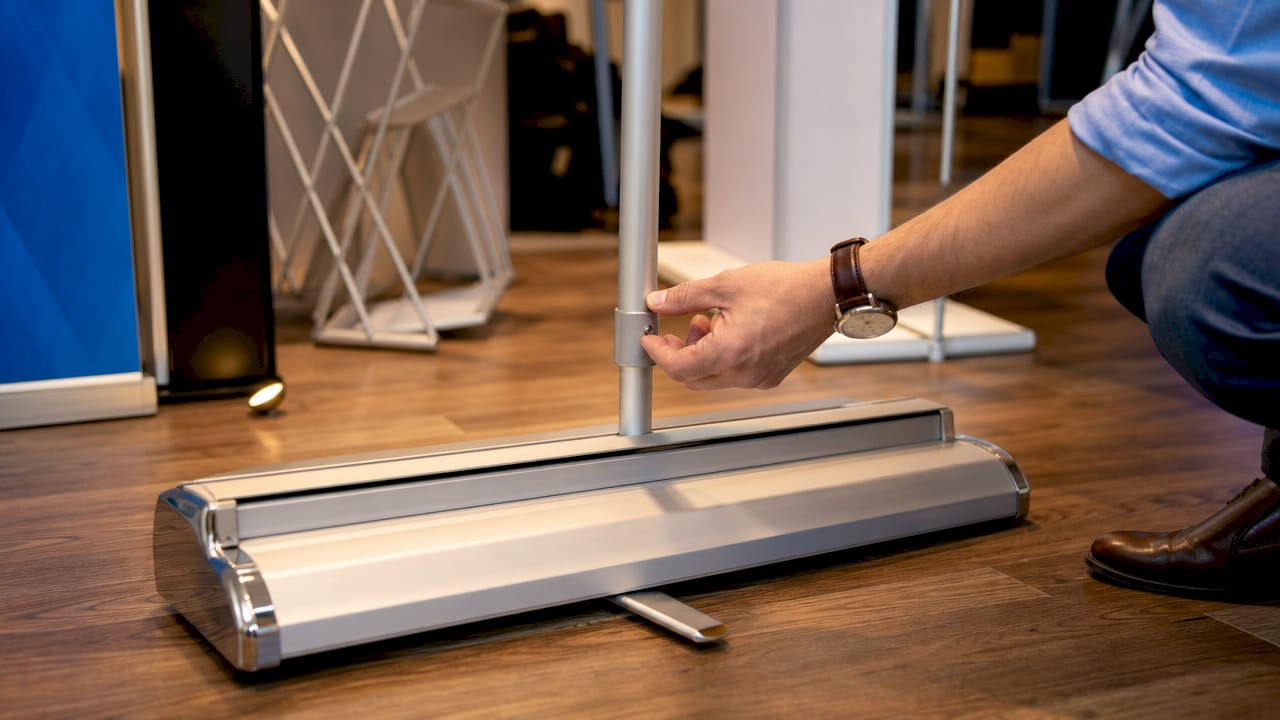
Three physical factors determine how stable a stand will be. Base weight is the most direct: heavier bases resist tipping in high-traffic areas where attendees brush past displays. Base footprint matters equally. A wide, flat base distributes load better than a narrow cassette. Pole rigidity determines whether the stand sways or holds firm when someone walks by quickly.
Most retractable banner stands are designed for indoor use. Outdoor conditions introduce wind, moisture, and uneven ground that expose every weakness in a lightweight unit. For outdoor events, choose stands with heavier bases and designs that allow some airflow through the graphic material, reducing the sail effect that causes tipping.
Before selecting a stand, answer these questions about your event environment:
- Is the floor carpeted, concrete, or uneven outdoor ground?
- Will the stand be attended at all times or left unattended?
- Is the venue air-conditioned with strong vents or open to outside air?
- How much foot traffic will pass within two feet of the display?
- Will the stand need to travel by car, train, or plane between events?
- Is the event indoors, outdoors, or in a covered outdoor space like a tent?
Pro Tip: For outdoor or high-traffic indoor events, consider a wide-base roll-up stand with a reinforced cassette. The wider footprint adds meaningful stability without significantly increasing packed weight.
What sizes and graphic materials best suit your visibility goals and usage frequency?
Viewing distance dictates banner size and layout. Banner widths commonly range from 800mm to 1200mm, with heights reaching close to 2 meters. Simple, large text works for displays viewed from across a room. Detailed product information or QR codes only make sense when viewers will stand within three feet of the display.
Graphic material choice affects both visual quality and long-term durability. The two main finish options each have a specific context where they perform best:
- Matte finish: Reduces glare under exhibition lighting and fluorescent overhead lights. Performs better in brightly lit trade show halls and retail environments. Preferred for text-heavy designs.
- Gloss finish: Produces more vibrant color saturation and sharper photo reproduction. Works well in lower-light environments or when the graphic is primarily image-based.
Gloss finishes enhance vibrancy but cause glare under strong exhibition lighting, which is why matte is the default recommendation for most trade show applications. Material choice also affects curling. Thicker graphic substrates resist the curl that develops when a banner is stored in a cassette for extended periods.
For businesses that update branding frequently, choose a stand with a replaceable graphic cassette. This lets you reuse the hardware while printing a new graphic for each campaign, which reduces cost per event significantly. PrintDrill’s custom retractable banners are available with hardware and graphic-only options for exactly this reason.
Usage frequency is the final filter. If you set up and tear down at more than ten events per year, invest in a stand with a durable mechanism and strong fittings. Budget stands fail faster under repeated use, and replacement costs add up quickly.
How to plan transport, storage, and hassle-free setup
Carry cases protect the mechanism and aid transport. Compact packed length matters when traveling by train or plane, where overhead storage and luggage restrictions apply. A stand that packs to under 40 inches fits in most car trunks and checked luggage without issues.
The table below outlines a reliable preparation, setup, and teardown sequence that minimizes errors, especially when event volunteers or temporary staff are handling the display.
| Stage | Action | Notes |
|---|---|---|
| Preparation | Inspect graphic and mechanism | Check for curling, cracks, or cassette damage before leaving for the event |
| Transport | Use the included carry case | Protects the cassette spring and prevents graphic scratching |
| Setup | Extend pole, attach top rail, pull graphic up | No tools required for most roll-up stands |
| Positioning | Place on level surface, away from vents | Reduces tipping risk and graphic flutter |
| Teardown | Retract slowly, do not force the spring | Forcing retraction is the most common cause of mechanism failure |
| Storage | Store vertically in carry case | Horizontal storage can stress the cassette and cause graphic curl |
Easy-to-use hardware reduces assembly errors, particularly among event volunteers who may not have set up a display before. Stands with color-coded poles or single-piece telescoping systems are worth the slight price premium when your team changes between events.
Pro Tip: Always do a full setup at your office before the event day. This confirms the graphic is correctly loaded, the pole height is set, and the mechanism retracts cleanly. Discovering a problem at the venue with no backup is a preventable situation.
How to match your banner stand choice to your event environment and brand presence
Multiple banners and coordinated placement create a visual zone that strengthens brand presence far more effectively than a single isolated display. A pair of roll-up stands flanking a table creates a defined brand space without requiring a full booth structure.
Venue lighting directly affects graphic readability. Warm-toned venue lighting shifts color perception, which means graphics designed under neutral studio lighting can look different on the show floor. Request a printed proof before finalizing your graphic file, and view it under conditions similar to your venue.
Placement strategy determines whether your display gets noticed or ignored. Consider these factors when positioning your stand:
- Place banners at eye level with the headline in the top third of the graphic, where it is visible above crowd height.
- Position QR codes between waist and chest height so attendees can scan without crouching or stretching.
- Avoid placing stands directly in front of bright windows or light sources that create backlit silhouettes.
- In high-traffic aisles, a double-sided retractable banner communicates to foot traffic from both directions simultaneously.
Pairing banner stands with complementary displays amplifies the effect. A tabletop retractable stand on a branded table cover, combined with a full-height roll-up stand behind it, creates a layered visual hierarchy that draws attention from a distance and holds it up close. For events where you also distribute materials, coordinating with trade show giveaways reinforces brand recall after the event ends.
Key takeaways
Choosing the right retractable banner stand requires matching stand type, base stability, graphic material, and placement strategy to your specific event environment and usage frequency.
| Point | Details |
|---|---|
| Match stand type to use case | Roll-up stands suit most events; tension stands suit permanent or high-end displays. |
| Prioritize stability for outdoor use | Heavier bases and wider footprints prevent tipping in outdoor or high-traffic environments. |
| Choose graphic finish by venue lighting | Matte finishes reduce glare under exhibition lighting; gloss suits lower-light settings. |
| Invest in durability for frequent use | Stands used at more than ten events per year require stronger mechanisms and fittings. |
| Plan setup and storage before the event | A pre-event test setup prevents on-site failures and protects the cassette mechanism. |
What I have learned from years of watching banner stands succeed and fail
The most common mistake I see from small business marketing teams is buying the cheapest roll-up stand available and then wondering why it looks unprofessional after three events. The mechanism degrades, the graphic curls, and the whole display leans slightly to one side. That is not a branding problem. It is a hardware problem.
The second mistake is treating every event as an indoor trade show. Outdoor markets, parking lot activations, and covered festival spaces have completely different requirements. A stand that performs well at a convention center can become a liability at an outdoor event with any wind at all.
My practical recommendation: buy one quality stand before buying five budget ones. Test it across three or four different event types. Note what works and what does not. Then scale your inventory based on real experience rather than assumptions. For businesses that attend conferences and trade shows regularly, a small inventory of two or three quality stands with interchangeable graphics is more cost-effective than a large collection of disposable units.
Future-proofing your investment means choosing hardware that accepts replacement graphics. Your branding will evolve. Your stand hardware does not need to.
— Printdrill
PrintDrill retractable banner stands: built for real events
PrintDrill offers a full range of custom retractable banners built for marketing professionals who need professional results without overcomplicating the process. Options range from lightweight indoor roll-up stands to the Deluxe Wide Base Roll-Up Banner for high-traffic or outdoor-adjacent environments. Every stand ships with a carry case and is available with full custom printing, free design assistance, and fast nationwide delivery.
PrintDrill’s team provides digital proofs before production, so the graphic you approve is the graphic you receive. Order a single unit or a complete event package. Fast turnaround options are available for last-minute events.
FAQ
Q: What is a retractable banner stand?
A: A retractable banner stand is a portable display unit where the printed graphic stores inside a base cassette and pulls upward along a support pole for display. It is also called a roll-up banner stand in the display industry.
Q: How do I choose between indoor and outdoor banner stands?
A: Most retractable banner stands are designed for indoor use. Outdoor events require heavier bases and airflow-stable designs to prevent tipping from wind or uneven ground.
Q: What size retractable banner stand works best for trade shows?
A: Banner widths between 800mm and 1200mm with heights near 2 meters suit most trade show environments. Choose size based on your viewing distance: larger text for far viewing, detailed content for close-up interaction.
Q: Does graphic finish matter for banner stands?
A: Gloss finishes produce more vibrant colors but cause glare under exhibition lighting. Matte finishes perform better in brightly lit trade show halls and are the standard recommendation for most event applications.
Q: How long do retractable banner stands last?
A: Stands with quality mechanisms and strong fittings are cost-effective for frequent use, handling more than ten events per year reliably. Budget stands degrade faster under repeated setup and teardown cycles.
Recommended
- Custom Tabletop Retractable Banner Stand | Portable Trade Show Displays – PRINTDRILL
- Custom Retractable Banners | Portable & Professional Displays – PRINTDRILL
- Step and Repeat Fabric Banner – Custom Backdrops for Events – PRINTDRILL
- Deluxe Wide Base Roll-Up Banner – Premium Retractable Banner Stand – PRINTDRILL
