

Double-Sided Banner Stand: What It Is and How It Works
TL;DR:
- A double-sided banner stand is a portable display featuring two independent graphic panels visible from opposite directions, ideal for high-traffic event environments. It uses opaque blockout materials between printed layers to prevent image bleed-through and typically includes reinforced bases for stability, making it suitable for open-floor placements. While more expensive than single-sided options, double-sided stands maximize visibility and impressions, especially when positioned at aisle junctions or entrance points.
A double-sided banner stand is a freestanding portable display that shows two independently printed graphic panels, one on each face, so your message reaches attendees approaching from any direction. In the trade show and event industry, this format is formally called a dual-sided or two-sided retractable banner stand. Understanding what a double-sided banner stand is, how it is built, and where to place it gives event planners a real edge in high-traffic environments like expos, conventions, and open-floor promotional events.
How does a double-sided banner stand work?
The core engineering of a double-sided stand separates it from a standard single-sided unit. Double-sided banner production uses opaque blockout materials sandwiched between the two printed layers to prevent graphic show-through. Without that layer, light and color from one side bleeds into the other, producing a ghosted, unreadable image.

Double-sided retractable roller banner stands feature two printed panels that retract independently from the same base, optimized for central positioning. Each panel rolls into its own cassette inside the base, so setup is fast and the graphics stay protected during transport.
Key construction details to know:
- Blockout core: An opaque layer, such as Ultraflex DSS 13 oz Pro Blockout, sits between the two printed faces. True blockout materials like this ensure no graphic bleed-through, maintaining clean visuals on both sides.
- Dual cassette mechanism: Each graphic panel retracts into its own roller, keeping tension even and preventing warping.
- Reinforced base: Double-sided roller banners include heavier, wider bases for stability since they support two banners, adding around 1–2 kg compared to single-sided units.
- Standard dimensions: Most dual-sided retractable stands run 33 inches wide by 80 inches tall, though custom sizes are available.
Pro Tip: Always confirm the blockout specification before ordering. A stand labeled “double-sided” but printed on standard vinyl without a blockout core will show ghost images from the opposite side, which looks unprofessional at any event.
What are the benefits of double-sided banner stands?
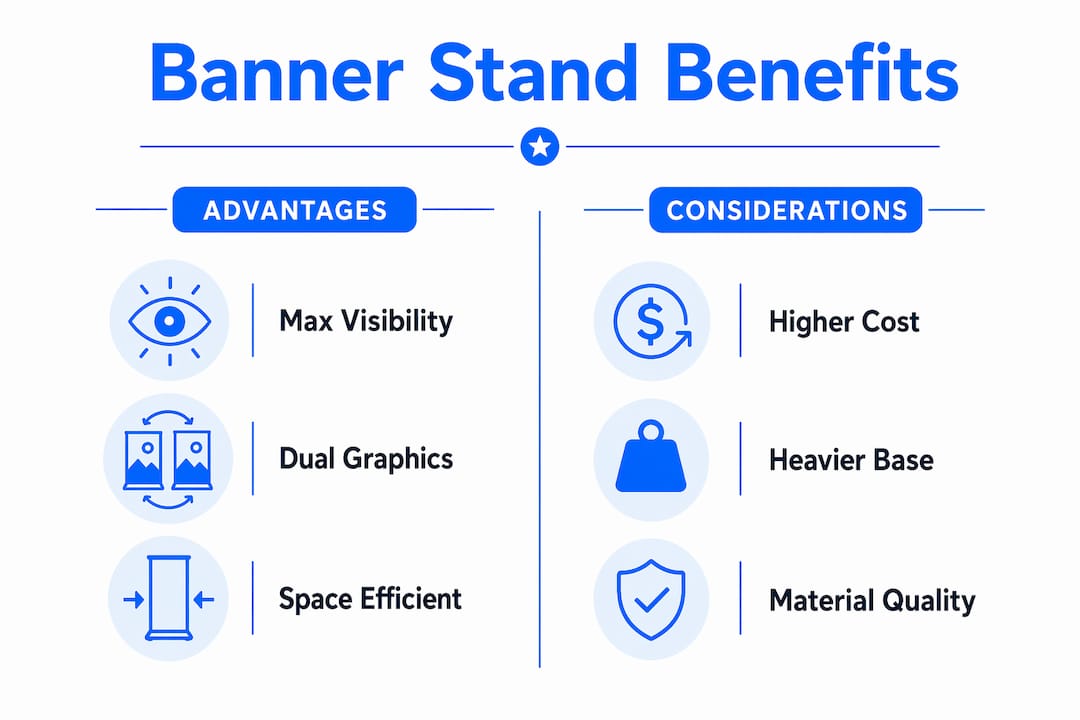
The primary benefit is straightforward: you get two visible faces from one floor footprint. Marketing professionals benefit from double-sided banners by capturing attention from both directions, effectively doubling impressions in premium event locations. That matters most when floor space is expensive and every square foot needs to work harder.
Here are the top reasons event planners choose dual-sided displays over single-sided alternatives:
- Maximized visibility in open environments. Double-sided banner stands are ideal for environments where attendees approach from multiple directions, such as open floors or island booths. A single-sided stand placed in the center of an aisle wastes the back face entirely.
- Higher impression count per unit. Placing one dual-sided stand at an aisle junction reaches two streams of foot traffic simultaneously. You do not need a second stand or a second floor space.
- Stronger perceived professionalism. A branded display visible from both directions signals preparation and investment. Attendees notice when a booth looks complete from every angle.
- Flexible messaging. You can run the same graphic on both sides for pure brand repetition, or use distinct messages, such as a product feature on one side and a call to action on the other.
- Better ROI on premium placements. End-cap positions and aisle intersections cost more to reserve. A dual-sided stand extracts full value from those spots.
The cost trade-off is real. Double-sided banners cost 40–70% more than single-sided due to materials, printing, and construction complexity. That premium is justified only when both sides will realistically be seen. If your booth is against a wall, a single-sided stand is the better buy.
Pro Tip: Before committing to dual-sided stands, walk your planned booth layout and mark every direction attendees will approach from. If traffic only comes from one direction, the extra cost does not pay off.
Design and placement tips for trade show events
Designing a double-sided banner for events requires a different mindset than designing for a wall-mounted display. Viewers approach from two directions, often while moving, so each face must communicate independently and clearly within about three seconds of viewing time.
Graphic design priorities for dual-sided displays:
- Treat each face as a standalone ad. Do not split one message across both sides. Each face needs its own headline, visual, and call to action.
- Avoid mirrored layouts. Mirrored graphics confuse viewers who walk around the stand. Use distinct color schemes or imagery to signal that each side is intentional.
- Use large, high-contrast typography. Passing viewers read at a distance. A headline set at 72 points or larger with strong contrast reads from 10 feet away. Smaller body copy is secondary.
- Keep the visual hierarchy simple. One dominant image, one headline, one supporting line. More than that competes for attention and loses the viewer before they stop.
For placement, open floor plans and aisle junctions are where dual-sided stands deliver the most value. Specific positions that work well include:
- The entrance to your booth, positioned perpendicular to the main aisle
- The center of an island booth, visible from all four sides when combined with additional stands
- High-traffic corridor intersections at convention centers
Stability matters more outdoors. The heavier base design of dual-sided stands helps indoors, but outdoor use requires sandbag weights or ground stakes. Wind load on two graphic faces is significantly higher than on one. Check with your venue on wind speed limits before placing dual-sided stands outside.
For guidance on sizing your graphics correctly before you order, Printdrill’s trade show banner sizing guide covers dimensions and design considerations for displays seen from multiple angles.
Retractable vs. other double-sided banner types
Not all dual-sided displays use the same format. The retractable stand is the most common, but fabric frames, fixed pole systems, and tension fabric displays each serve different needs. Here is how the main options compare:
| Format | Portability | Setup Time | Visual Impact | Best Use Case |
|---|---|---|---|---|
| Retractable (roll-up) | High | Under 5 minutes | Sharp, photo-quality | Trade shows, expos, indoor events |
| Fixed frame with fabric | Medium | 10–20 minutes | Premium, wrinkle-free | Corporate events, long-term displays |
| Tension fabric popup | Low | 20–30 minutes | Large-format, bold | Large booths, permanent installations |
| Pole banner (outdoor) | Medium | 10–15 minutes | High visibility outdoors | Street events, outdoor markets |
Double-sided retractable banner stands are portable, easy to set up, and suitable for high-traffic trade show booths requiring a professional appearance on both sides. That combination of speed and quality makes them the default choice for exhibitors who travel frequently or set up at multiple events per year.
Fixed frame fabric stands deliver a cleaner, more premium look because the graphic is stretched taut rather than rolled. The trade-off is longer setup and a larger carrying case. For exhibitors with a permanent or semi-permanent installation, fabric frames are worth the extra effort. For teams setting up and breaking down at three events a month, retractable stands win on practicality every time.
Custom retractable banners are also available in single-sided configurations, which cost less and work well for wall-adjacent placements where only one face will be seen.
Key takeaways
A double-sided banner stand delivers maximum visibility from a single floor position, but only when the blockout material, placement, and graphic design are all executed correctly.
| Point | Details |
|---|---|
| Blockout material is non-negotiable | Without an opaque core layer, graphics bleed through and look unprofessional on both sides. |
| Placement determines ROI | Dual-sided stands pay off only in open-floor or multi-directional traffic settings, not against walls. |
| Cost premium is real | Double-sided banners cost 40–70% more than single-sided; confirm both faces will be seen before ordering. |
| Each face needs its own message | Treat both sides as independent ads with distinct headlines, visuals, and calls to action. |
| Retractable format suits most exhibitors | Fast setup, high portability, and professional print quality make retractable stands the practical default. |
What i’ve learned from watching double-sided stands succeed and fail
After working with exhibitors across dozens of trade shows and expos, one pattern is consistent: the stands that deliver results are placed in genuinely open positions, and the ones that disappoint are pressed against a back wall because the exhibitor ran out of floor space.
The material quality issue is underestimated. Buyers often focus on price and skip the blockout specification. At a busy expo under bright lighting, a stand with poor blockout material looks like a mistake. It signals to attendees that the brand cut corners. That perception is hard to recover from in a 10-minute booth visit.
Operationally, the added weight of a dual-sided stand is a real factor. Dual-sided stands require additional planning for transport, including potentially extra staff or equipment. A single-sided stand fits easily in an overhead bin. A dual-sided unit often needs checked baggage or a shipping case. Build that into your event budget before you order.
The best use I have seen is pairing one dual-sided retractable stand at the booth entrance with a full tension fabric trade show booth as the back wall. The retractable stand pulls in traffic from the aisle. The backdrop closes the sale visually once attendees step inside. That combination works because each element does a specific job.
— Printdrill
Get custom double-sided banners from Printdrill
Printdrill produces custom double-sided retractable banners built with commercial-grade blockout materials, vibrant large-format printing, and fast nationwide delivery. Every order includes free design assistance and a digital proof before production.

For events requiring lightweight, wrinkle-resistant displays, Printdrill’s custom fabric banners are available in double-sided configurations suited for corporate events and long-term installations. The full product range covers everything from individual retractable stands to complete trade show booth kits, so you can build a cohesive display package without sourcing from multiple vendors. Contact Printdrill to discuss your event requirements and get a quote.
FAQ
Q: What is a double-sided banner stand?
A: A double-sided banner stand is a freestanding portable display with two independently printed graphic panels, one on each face, designed to show your brand message to audiences approaching from opposite directions.
Q: What materials prevent graphic bleed-through on double-sided banners?
A: Opaque blockout materials, such as Ultraflex DSS 13 oz Pro Blockout, are sandwiched between the two printed layers to block light and prevent one side’s graphics from showing through to the other.
Q: When should i choose a double-sided stand over a single-sided one?
A: Choose a double-sided stand when your placement is in an open floor, aisle junction, or island booth where attendees approach from multiple directions. If the back of the stand faces a wall, a single-sided unit is the better value.
Q: How do i set up a double-sided retractable banner stand?
A: Most retractable double-sided stands set up in under five minutes. Extend the support pole, attach it to the top of each graphic panel, and pull each banner up from its cassette in the base. No tools are required.
Q: Where can i buy custom double-sided banner stands?
A: Printdrill offers custom double-sided retractable banner stands with blockout materials, professional printing, and free design support, available online with fast shipping across the United States.
Recommended
- Double-Sided Retractable Banner | Two-Sided Roll-Up Display – PRINTDRILL
- Step and Repeat Fabric Banner – Custom Backdrops for Events – PRINTDRILL
- S-Shaped Banner Stand With Shelves | TV Mount Tension Fabric Display – PRINTDRILL
- S-Shaped Fabric Banner Stand | Curved Tension Display for Trade Shows – PRINTDRILL
