

Exhibition Backdrop Types Explained for Event Planners
TL;DR:
- Exhibition backdrops are branded display walls designed to create professional backgrounds at trade shows, with types like pop-ups, tension fabric, SEG, step-and-repeat, and modular systems. Choosing the right format depends on setup speed, visual quality, and booth layout, impacting brand credibility and visual impact. Material choice and features like backlighting influence branding effectiveness, with fabric systems offering durability and versatility for frequent events.
Exhibition backdrops are defined as branded display walls designed to create a clean, professional background behind tables, product displays, or presentation areas at trade shows and events. The five primary types; pop-up displays, tension fabric systems, SEG (Silicone Edge Graphics) walls, step-and-repeat backdrops, and modular configurations; each serve different goals based on setup speed, visual finish, and booth footprint. Choosing the wrong type costs you more than money. It costs you brand credibility on the floor. This guide breaks down every major format so you can match the right display to your event goals.
Exhibition backdrop types explained: pop-up, tension fabric, and SEG
These three formats cover the majority of trade show backdrops in use today. Understanding how each is built tells you exactly where each one belongs.
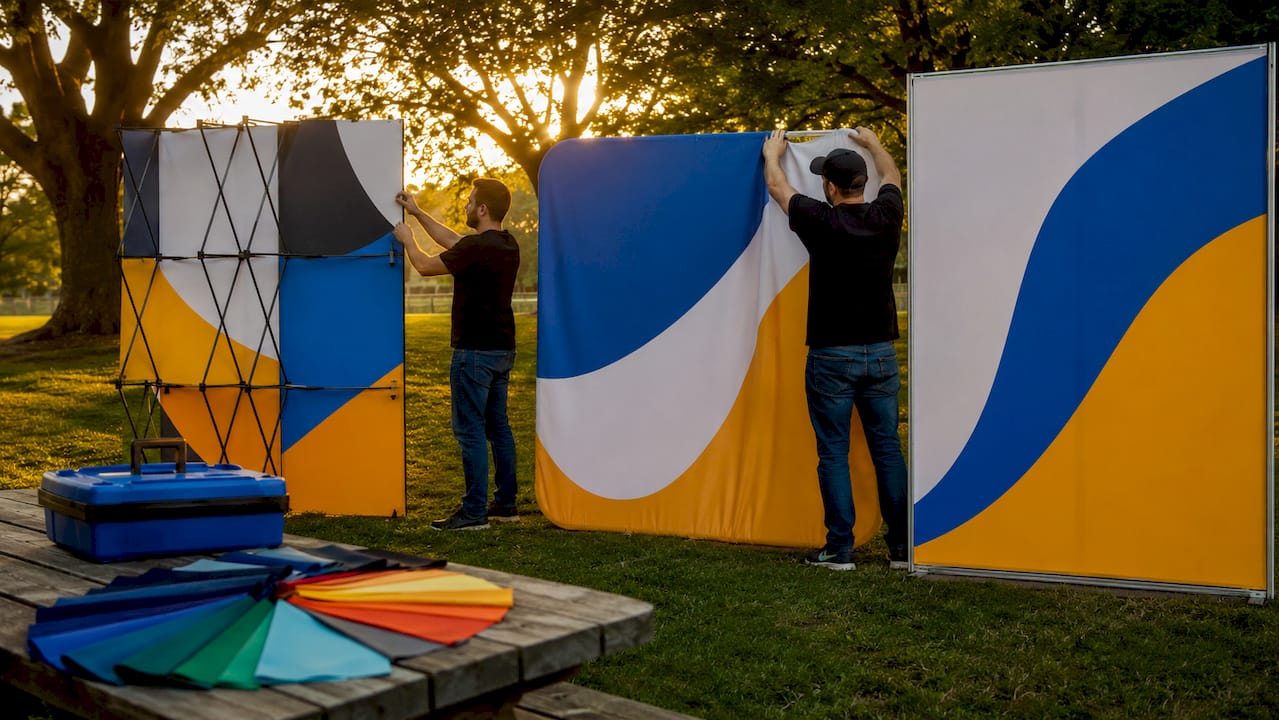
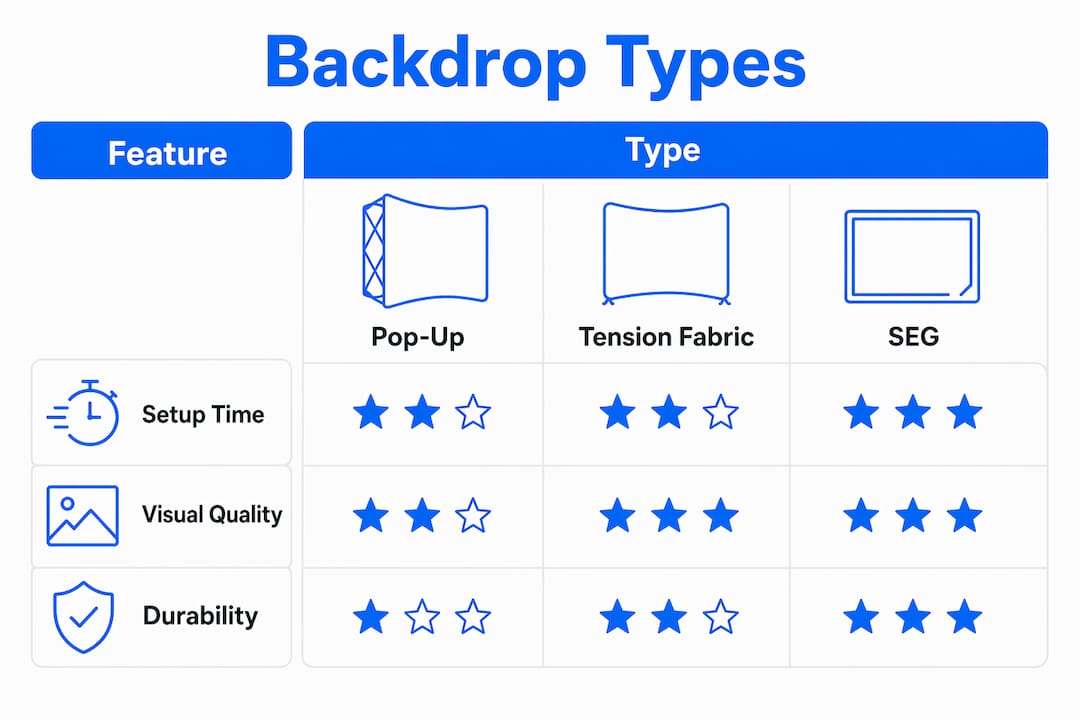
Pop-up displays use an accordion-style frame with magnetic or Velcro graphic attachments. One person can assemble a full 10-foot pop-up in 2 to 5 minutes without tools. That speed makes pop-up displays the default choice for solo exhibitors, road-show marketers, and anyone attending multiple events per month. The trade-off is a visible frame structure and a slightly less polished finish compared to fabric-based systems.
Tension fabric displays, also called pillowcase backdrops, use a zipper-closed fabric sleeve stretched over an aluminum frame. Setup takes 5 to 10 minutes and produces a smooth, wrinkle-free surface with the option for curved or shaped edges. Printdrill’s tension fabric pillowcase backdrops are a strong example of this format, available in 8ft, 10ft, and 20ft widths for booths of any scale. The pillowcase system is the most popular middle-ground option because it balances portability with a clean, professional appearance.
SEG displays deliver the highest visual quality of the three. Silicone-beaded fabric graphics are tucked into a recessed channel on a rigid aluminum frame, creating a drum-tight, seamless finish. Setup runs 15 to 20 minutes due to precise frame alignment, but the result looks closer to a built environment than a portable display. SEG frames also support backlighting, which makes them the preferred format for premium brand presentations. Printdrill’s 20 ft SEG LightBox Display is purpose-built for this use case.
| Feature | Pop-Up | Tension Fabric | SEG |
|---|---|---|---|
| Setup time | 2 to 5 minutes | 5 to 10 minutes | 15 to 20 minutes |
| Visual finish | Good | Very good | Premium |
| Portability | High | High | Moderate |
| Backlighting support | No | Limited | Yes |
| Best for | Solo exhibitors, frequent events | Mid-range booths | High-profile branding |
Pro Tip: If you set up alone at events more than four times per year, prioritize pop-up or tension fabric over SEG. The time savings across a full event calendar outweigh the visual upgrade SEG provides.
How do step-and-repeat and modular backdrops differ?
Step-and-repeat and modular backdrops serve specialized purposes that go beyond a standard branded wall. Knowing when to deploy each one separates average booth design from a display that works across multiple marketing channels.
Step-and-repeat backdrops are designed specifically for photography. The format repeats a logo or pattern across the entire surface so that every photo taken in front of it captures brand identity regardless of where the camera is framed. Logo spacing and camera framing are the two most critical design variables. Logos placed too close together create visual noise in photos. Logos spaced too far apart leave gaps that reduce brand recognition. The standard rule is to offset rows so no photo angle captures a blank zone. Printdrill offers both step-and-repeat fabric pop-up displays and custom step-and-repeat banners in vinyl and fabric for events at any scale.
Modular backdrops take a different approach. Rather than a single flat wall, modular systems connect multiple panels to create L-shaped, T-shaped, or multi-sided configurations. 3D L- and T-shaped backdrops offer visibility from multiple angles and work well in corner booths or open-floor layouts where foot traffic approaches from more than one direction. Tool-free snap-fit connections and fabric sleeves zipped closed give these systems a taut, finished look without requiring an installation crew.
Key considerations when choosing between these two formats:
- Step-and-repeat: Use when your event generates photography, press coverage, or social media content. Red carpet activations, product launches, and award ceremonies are the primary use cases.
- Modular systems: Use when your booth occupies a corner space, requires product shelving, or needs to incorporate monitors and interactive elements.
- Hybrid configurations: Some exhibitors combine a modular frame with a step-and-repeat graphic panel at the back wall, capturing both photo-op value and structural flexibility.
- Traffic flow planning: Modular L-shapes direct attendee movement through the booth. A well-placed T-shape creates a natural stopping point that increases dwell time.
Pro Tip: For step-and-repeat backdrops, test your logo layout by photographing a printed proof from 8 to 10 feet away before ordering the full display. What looks balanced on screen often reads differently through a camera lens.
What design features and materials affect branding effectiveness?
The material and finish of an exhibition backdrop directly determine how your brand reads from 20 feet away. This is where many exhibitors underinvest.
Dye-sublimation polyester is the standard fabric for trade show backdrops. Stretch polyester with dye-sublimation printing delivers vivid colors, wrinkle resistance, and durability across multiple events. The dye bonds to the fiber rather than sitting on the surface, which means graphics stay sharp after repeated folding, packing, and transport. Vinyl banners remain an option for short-term or one-time events where cost is the primary concern, but they wrinkle more easily and carry more weight.
Backlighting is the single biggest upgrade available in exhibition display design. Backlit displays create memorable visual impact in dim convention hall lighting, drawing attendee attention from across the floor. SEG frames are the primary vehicle for backlighting because the rigid channel holds LED light panels securely behind the graphic. Backlit SEG displays deliver a high-end appearance that supports brand prestige and allow graphics to be swapped out between events without replacing the frame.
| Material | Finish quality | Durability | Weight | Best use |
|---|---|---|---|---|
| Dye-sublimation polyester | Excellent | High | Light | Multi-event exhibitors |
| Stretch fabric | Very good | High | Very light | Tension and SEG frames |
| Vinyl | Good | Moderate | Heavy | One-time or outdoor events |
| Rigid panels | Premium | Very high | Heavy | Permanent or semi-permanent installs |
Maintenance also affects long-term value. Fabric backdrops can be hand-washed or machine-washed on a gentle cycle, then rehung to dry wrinkle-free. Vinyl requires wipe-down cleaning and careful rolling to avoid crease marks. Rigid panels need protective cases for transport. For exhibitors attending more than six events per year, fabric systems pay for themselves through reuse alone.
How to choose the best exhibition backdrop for your event
Matching backdrop type to event context is a straightforward process when you work through the right decision factors in order.
- Define your booth footprint first. A 10x10 inline booth calls for a single flat backdrop. A 10x20 or corner booth opens the door to modular or curved tension fabric configurations. Printdrill’s 10x20 curved tension fabric booth is designed specifically for larger footprints that need a continuous branded surface.
- Assess your setup team. One person with no tools points to pop-up or pillowcase tension fabric. A two-person team with 30 minutes of setup time can handle SEG or modular systems without stress.
- Count your annual events. One or two events per year justifies a lower-cost vinyl or basic pop-up solution. Six or more events per year makes dye-sublimation fabric and a reusable frame the more cost-effective choice over time.
- Identify your primary visual goal. Photography and social media content require step-and-repeat. Premium brand presence in a high-traffic hall requires SEG with backlighting. General brand visibility at a mid-size expo is well served by tension fabric.
- Check venue lighting conditions. Dark or dim convention halls amplify the return on backlit displays. Well-lit venues reduce the advantage of backlighting and make standard fabric finishes equally effective.
- Plan for graphic updates. SEG and modular frames accept replacement graphics without replacing the frame. If your messaging changes seasonally or by campaign, invest in a frame system that separates hardware from graphics.
A booth backdrop designed as a clean branded wall behind your table or product display improves attendee focus and keeps the visual hierarchy clear. The backdrop should complement your products and staff, not compete with them.
Key takeaways
The most effective exhibition backdrop matches setup speed, visual finish, and material durability to the specific demands of your event calendar and booth configuration.
| Point | Details |
|---|---|
| Pop-up for speed | Pop-up displays assemble in 2 to 5 minutes and suit solo exhibitors at frequent events. |
| SEG for premium finish | SEG systems deliver drum-tight graphics and full backlighting support for high-profile branding. |
| Fabric outlasts vinyl | Dye-sublimation polyester handles repeated events, washing, and transport better than vinyl. |
| Step-and-repeat for photo ops | Logo spacing and camera framing determine whether step-and-repeat backdrops generate usable brand content. |
| Match to booth footprint | Corner and open-floor booths benefit from modular L- or T-shaped configurations for multi-angle visibility. |
What working with exhibition displays taught me about backdrop selection
Most exhibitors focus on graphic design first and backdrop type second. That order is backwards. The structure you choose determines what your graphic can actually do.
I have seen beautifully designed graphics lose all their impact because they were printed on a pop-up frame that bowed slightly under convention hall air conditioning. The same graphic on a tension fabric pillowcase system would have read perfectly from 30 feet away. The frame is not a commodity decision. It is a visual decision.
The other mistake I see consistently is treating step-and-repeat backdrops as a secondary element. Exhibitors order them last, size them to fit leftover budget, and then wonder why their event photos look generic. A step-and-repeat backdrop that appears in 200 social media posts during a single event generates more brand impressions than the booth itself. That math should change how much attention it gets during planning.
Modular systems get underused by mid-size exhibitors who assume they are only for large booths. A well-configured L-shape in a standard 10x10 corner space creates a defined brand environment that flat backdrops cannot replicate. The enclosed feel increases dwell time, and dwell time increases conversion.
The practical rule is this: buy the frame once, update the graphic. SEG and modular systems cost more upfront but carry a lower cost per event over a three-year horizon than replacing pop-up graphics every season.
— Printdrill
Custom exhibition backdrops from Printdrill
Printdrill produces custom fabric and tension fabric backdrops for trade shows, corporate events, and brand activations across the United States. Whether you need a single custom fabric banner for a pop-up event or a full tension fabric booth kit for a national conference, every product ships with free design assistance and fast turnaround options.
For outdoor events or venues with high foot traffic, Printdrill’s custom mesh banners offer outdoor-grade durability with wind-resistant construction and full-color printing. Browse the full range of backdrop and display options to find the right format for your next event.
FAQ
Q: What are the main types of exhibition backdrops?
A: The five main types are pop-up displays, tension fabric (pillowcase) backdrops, SEG (Silicone Edge Graphics) walls, step-and-repeat backdrops, and modular panel systems. Each type differs in setup time, visual finish, and ideal use case.
Q: Which exhibition backdrop is easiest to set up?
A: Pop-up displays are the fastest, requiring only 2 to 5 minutes for a single person to assemble without tools. Tension fabric pillowcase systems are the next fastest at 5 to 10 minutes.
Q: What material is best for a reusable trade show backdrop?
A: Dye-sublimation polyester is the best material for repeat use. It resists wrinkles, holds color through multiple events, and can be washed and repacked without degrading print quality.
Q: When should I use a step-and-repeat backdrop?
A: Use a step-and-repeat backdrop when your event generates photography, press coverage, or social media content. Proper logo spacing and camera framing are critical to making the design work in photos.
Q: Do exhibition backdrops work with backlighting?
A: SEG frames are specifically designed to support LED backlighting behind the graphic panel. Backlit displays perform best in dim convention halls where they draw attention from across the floor.
